
Upward educational mobility in France over three generations: a gap persists in the case of grandchildren of North African immigrants
A new study based on France’s Trajectoires et Origines 2 (TeO2) survey* has just been published in The American Sociological Review. The study moves beyond the usual research scope of two generations, revealing that educational disparities between immigrants’ descendants and France’s majority population have not been entirely effaced after three generations. Researchers Mathieu Ferry (Université de Versailles Saint-Quentin-en-Yvelines), Milan Bouchet-Valet, Mathieu Ichou and Ognjen Obućina (INED), together with Lucas G. Drouhot (NYU Shanghai) found that while the grandchildren of Southern European immigrants have attained the same completed education level as families without a migration history, in the case of North African immigrants’ grandchildren a gap persists. This group have made real progress, but it goes together with a greater risk of downward educational mobility related to segregation or discrimination mechanisms documented by existent scientific studies.
Tracking education trajectories over three generations
Drawing on representative data from the TeO2 survey (INED-INSEE 2019-2020), the researchers were able to compare the educational levels of grandparents, parents, and grandchildren (first, second, and third generations) in more than 4,000 families living in France and that either have or do not have a migration history. There are very few equivalents of this approach elsewhere in the world, as most studies consider only two generations. And it enabled the researchers measure long-term educational mobility and to assess French society’s ability to reduce disparities by origin.
Massive catching up in immigrant families but differences by origin
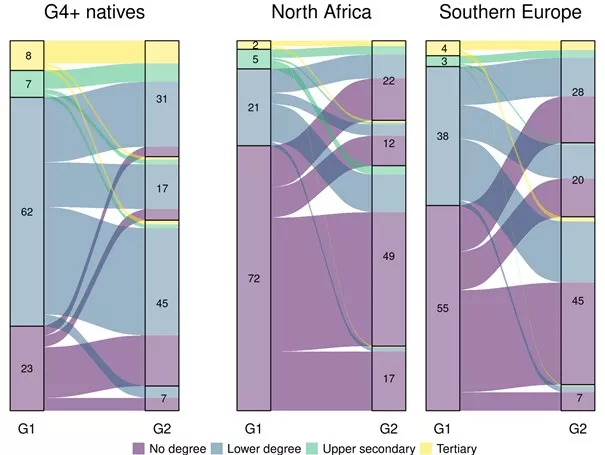
The results show that completed educational level, i.e., highest educational degree, has risen sharply from one generation to the next in all families with a migration history, in part because the first generation arrived with a low level of schooling. 55% of first-generation Southern European immigrants had no completed education (as opposed to 23% of the majority population), whereas their grandchildren, the third generation or G3, now show completed education levels comparable to those of descendants of families without a migration history, a development involving massive access to higher education. However, despite strong progress over the generations, the grandchildren of North African immigrants—72% of those grandchildren’s grandparents had no completed education—have not attained the completed education level of the majority population (46% of them pursued higher education, as against 55% of native families).
The study also shows that educational attainment levels are not transmitted as well from one generation to the next in families of North African descent. With social origin controlled for, both downward educational mobility (when parents or grandparents hold educational degrees higher than those of their children or grandchildren) and its opposite, upward educational mobility, occur more frequently in this group than in the majority population. This in turn means that social reproduction is not as strong in families of North African, while the positive connotation generally attributed to that situation is absent because, in their case, the result can be a lower completed education level. To describe this phenomenon, the English-language literature uses the term “perverse openness” [trompe-l’oeil mobility].
Historical and social obstacles still operative
While the study does not directly discuss the factors that might explain these differences by origin, many existing studies of immigrants’ children (the second generation or G2) have brought to light a combination of historical factors, persistent forms of residential segregation, and discrimination that have a heavier impact on families of North African descent than those of Southern European origin. The colonial past, certain social representations around origin or religion, as well as regional disparities continue to slow the educational ascent of grandchildren of North African immigrants or G3. Earlier sociological studies have shown that the children of those immigrants (G2) more often live in poor neighborhoods (a phenomenon that tends to become more pronounced) and to attend more intensely segregated schools where learning conditions are relatively unfavorable to their academic success. The researchers’ tests also showed that having a North African-sounding name diminishes peoples chances of receiving a reply to a request for information on a Master’s Degree program.
A challenge to effective equal opportunity
In France, where one-third of the population are either immigrants, children of a least one immigrant parent, or grandchildren of at least one immigrant grandparent, these results call into question whether France’s republican model can guarantee real equal opportunity. The authors stress that battling academic disparities must remain a central public policy concern, notably to prevent intergenerational reproduction of origin-related disadvantages.
Key figures
|
Reading note: 23% of grandparents in the majority population had no qualifications, as did 5% of their grandchildren.

*TeO2 survey: the Trajectoires et Origines 2 survey [TeO2) [Trajectories and Origins 2] is a statistical survey jointly conducted by INED and INSEE between 2019 and 2020; it follows on the first INED-INSEE TeO survey of 2008-2009. The survey, representative of the population living in metropolitan France, questioned 27,000 people by way of a detailed questionnaire on their life paths, those of their parents, and those of their children. The aim is to measure the impact of origins and living conditions on access (or exposure) to the main areas of social life: education, employment, housing, health, civic life [la vie citoyenne], social and family relations, to which must be added discrimination. TeO2 offers for the very first time the possibility to analyze social and educational mobility over three generations, by comparing the trajectories of the first, second, and third generations. Due to its wealth of data, TeO2 is now a key source for understanding integration dynamics, trajectory diversity, and inequalities in access to resources in French society. |
Source : Mathieu Ferry, Milan Bouchet-Valat, Lucas G. Drouhot et al., 2025, Shades of Égalité: Educational Mobility and Ethnoracial Hierarchy Over Three Generations in France, American Sociological Review