


Family structure pyramid
Thr distribution of family types varies across age groups
Read more

This graph shows the excess mortality of males with respect to females in France over the last 200 years. Excess male mortality is measured as the male/female ratio of the probability of dying at a given age, for different groups of years from the early 19th century to the early 21st century: 1820-1824, 1900-1904, 1950-1954, 1990-1994 and 2000-2004.
this graph shows the variations in life expectancy in France from 1740 to 2020
This graph shows the excess mortality of males with respect to females in France over the last 200 years. Excess male mortality is measured as the male/female ratio of the probability of dying at a given age, for different groups of years from the early 19th century to the early 21st century: 1820-1824, 1900-1904, 1950-1954, 1990-1994 and 2000-2004.
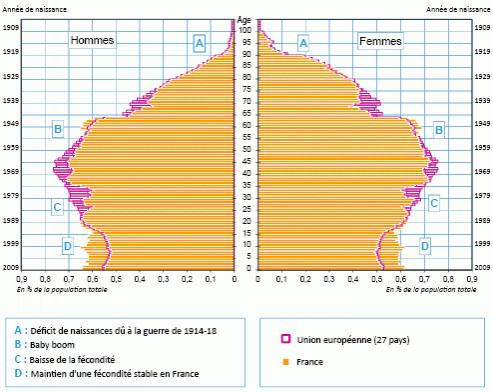
France’s population pyramid for 2010 was shaped by twentieth-century history: a birth deficit during the 1914-1918 war years, the baby boom of 1946-1973, relative birth rate stability for the past 35 years
This graph shows natural population increase and net migration in the EU-15 countries in 2002.
Each country is represented by a bar whose width is proportional to its population size per 1,000 inhabitants. The countries are ranked by their total growth rate (natural increase + net migration).
For each period, the graph plots the distribution of countries by their level of fertility. The countries are ranked by the mean number of children per woman. For each level of fertility, the curve shows the proportion of the world population living in a country where fertility is below that level.
Ce graphique montre la fécondité par âge en Europe en 2016. Le taux de fécondité représente la probabilité à chaque âge de mettre au monde un enfant.
This graph presents the population of the European Union, from its initial formation, through successive enlargements, up to the present day.
This graph shows the relationship between two demographic indicators : fertility and infant mortality. The values along the horizontal axis indicate the level of infant mortality in each country of sub-Saharan Africa over the period 2000-2004, i.e. The values along the vertical axis indicate the level of fertility in each country over the same period, expressed as the average number of children per woman.
On these two world maps, the countries are represented by rectangles whose surface area is proportional to their estimated population in 2000 (top) and their projected population in 2050 (bottom). Both these population cartograms are constructed on the same scale, so the population change between the two dates can be compared.
Ce graphique représentant l'évolution du nombre des hommes se dessine sur deux axes : L'axe horizontal représente les années, de l'an -65 000 à l'an +5000. L'axe vertical indique l'effectif total de la population mondiale.