
In France, as in Europe as a whole, net migration offsets the excess of deaths over births
Abstract
In France, the number of deaths exceeded the number of births in 2025. But the population grew, with positive net migration more than offsetting negative natural population change. In the same way, across the European Union’s 27 countries, deaths have also exceeded births since 2012. But because Europe’s net migration has more than offset its negative population change until now, the EU-27’s population grew from 441 to 450 million inhabitants between 2012 and 2025.
Article
In 2025, there were more deaths than births in France. Is the same true elsewhere in Europe? Are some countries still experiencing a natural increase? Is the population shrinking in countries where natural change is negative? What is the impact of migration flows? Gilles Pison analyses France’s demographic situation and compares it with those of neighbouring countries and the European Union as a whole.1
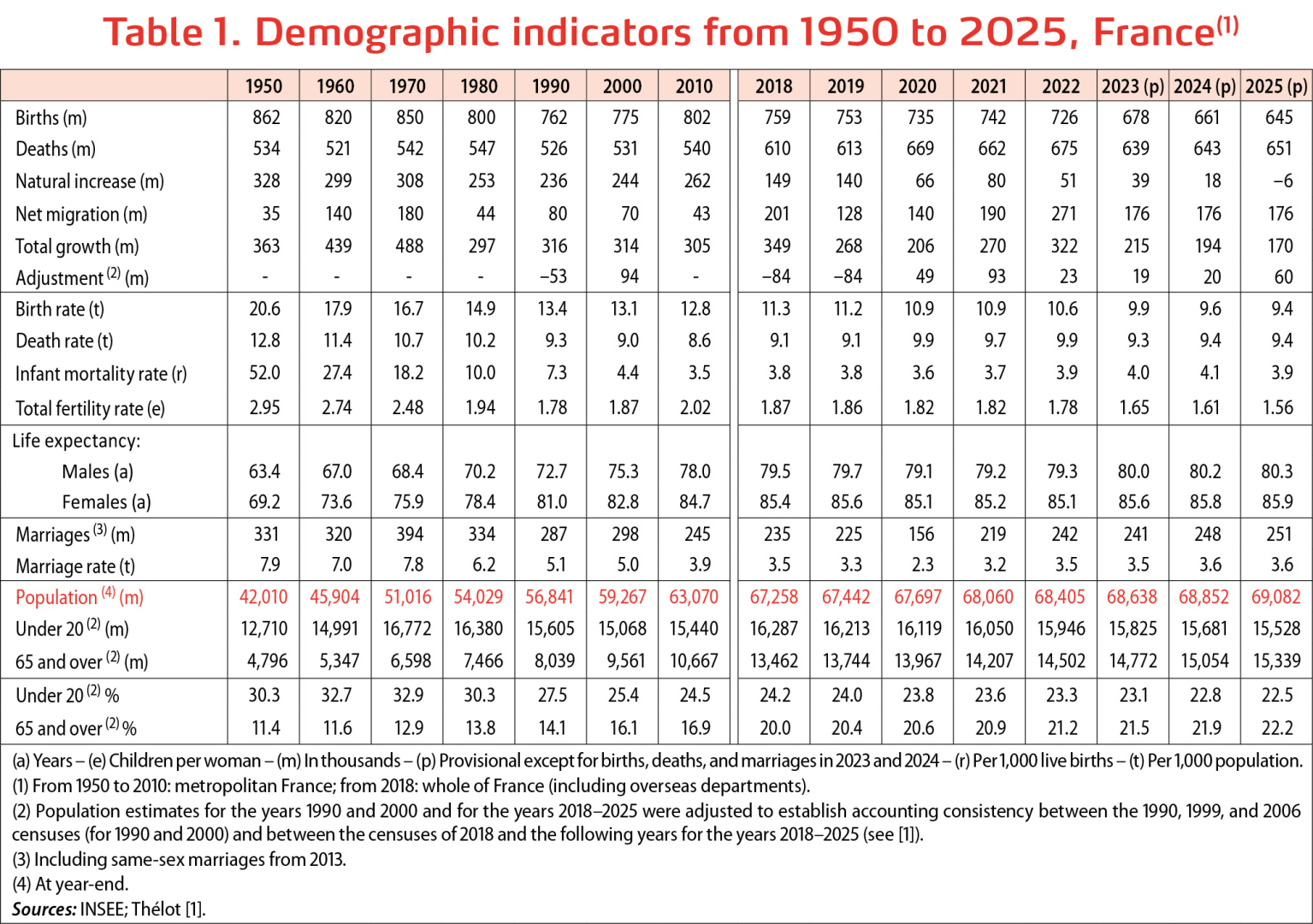
On 1 January 2026, the population of France was estimated at 69.1 million inhabitants, 66.8 million of whom live in metropolitan France and 2.3 million in the country’s overseas departments [1]. The population grew by 0.25% in 2025 (Table 1). Natural change, the difference between the numbers of births and deaths, was negative for the first time since the end of the Second World War. Over the past 10 years it has fallen from +205,000 (in 2015) to –6,000 (in 2025). Three-quarters of this decline is attributable to a reduction in the number of births (154,000 fewer) and the remaining quarter to an increase in deaths (57,000 more).
More deaths: an echo of the baby boom 80 years ago
The 651,000 deaths observed in 2025 represent a 1.2% increase compared to 2024, bearing in mind that the population grew by 0.25% and the proportion of older adults increased. Calculating life expectancy removes the effect of population size and age distribution on fluctuations in mortality, retaining only the changes associated with varying risks of death. Life expectancy at birth rose to 80.3 years for men and 85.9 for women in 2025, up from 80.2 and 85.8 years respectively in 2024. This gain of 0.1 year for each sex is only a modest increase and is partly explained by the excess mortality caused by seasonal flu in early 2025 [1]. It is, however, average in terms of progress in life expectancy over the past 10 years. Life expectancy has increased from 85.1 years in 2015 to 85.9 in 2025 among women, (+0.8 years over 10 years), and from 79.0 to 80.3 years among men (+1.3 years).
The number of deaths is expected to continue increasing over the coming years, even if life expectancy continues to progress. The large baby-boom generations, born between 1946 and 1974 and aged between 52 and 80 in 2026, will grow old and die over the coming decades, contributing to an increase in the number of deaths (Figure 1) [2]. This number could rise by 200,000 by 2050 if life expectancy continues to progress at same pace as in recent years [3], and would then fall slightly in the 2060s as the last of the baby-boomers pass away.
Births and fertility continue to decline
The number of annual births in France is declining (661,000 in 2024 and 645,000 in 2025), as is the total fertility rate: 1.61 children per woman in 2024 and 1.56 in 2025. Maternal age at childbirth has been rising for 50 years and the trend continues in this direction: average age at childbirth in 2025 was 31.2 years, compared with 26.5 in 1977.
Women born in 1975, who turned 50 in 2025 and have reached the end of their reproductive years, have had 2.03 children on average. Those born in 1985 have already had 1.96 children, the same number as the women 10 years older had at the same age, so their total number of children is also likely to reach at least 2.0 by the time they turn 50. Women born in 1995 have had 0.82 children, but it is difficult to predict how many they will have had by their 50th birthday. According to recent trends in terms of desire for family and children, this figure could lie between 1.6 and 1.9 [4].
Positive net migration more than compensates for the excess of deaths over births
Despite the excess of deaths over births, the French population grew by 0.25% in 2025, as mentioned above, due to net migration, estimated by INSEE at +176,000, a figure vastly outstripping the negative natural change of –6,000. As long as definitive census data are not available, net migration is temporarily estimated as the average of the last three available definitive net migration figures (five are used when making the calculation for Mayotte).2 The resulting estimation is the difference between arrivals on French territory—and this number is growing, [5]—and departures from it.
Negative natural change is likely to intensify over coming years due to the expected rise in deaths, even if births stabilize. This will not necessarily result in the shrinking of the population provided that net migration continues to offset natural population decline. This could be the case for at least another 10 years or even longer if net migration remains at +176,000 per year and the birth rate does not decline further. If fertility continues to fall, natural population change will decline further and the population could plateau sooner.
What is happening elsewhere in Europe? Is natural population change negative as in France, or are some countries still experiencing natural growth? The most recent year for which comparisons are possible using Eurostat statistics is 2024 (Figure 2). In that year, natural population change in France was still positive, as it was in six other smaller countries: Sweden (10.6 million inhabitants), Denmark (6.0), Ireland (5.3), Cyprus (1.4), Luxembourg (0.7), and Malta (0.5). Of the 20 countries experiencing negative natural change, eight saw their population shrink in 2024: Italy, five Central European countries (Bulgaria, Hungary, Poland, Romania, and Slovakia), and two Baltic States (Estonia and Latvia). In the other 12 countries, positive net migration more than offset this deficit and the population grew. Some countries have recorded more deaths than births for over 10 years now, including Germany, Italy, Hungary, and Romania, and the population is shrinking in all these countries except for Germany. Until now, Germany’s high levels of net migration have more than offset its negative natural change.
Across the whole of the EU-27 (450 million inhabitants), 3.56 million births and 4.82 million deaths were recorded in 2024, with deaths therefore exceeding births by 1.26 million. This excess is more than offset by positive net migration, estimated at 1.5 million.
Natural population change in the European Union has been negative since 2012
Births and deaths curves for the EU-27 intersected in 2012 (Figure 3a). The number of births stood at around 6.7 million per year in the early 1960s—during the baby boom—and then fell in subsequent years, reaching 4.4 million in 2012. The number of deaths, recorded at around 3.5 million per year in the early 1960s, then increased, first matching and then exceeding the number of births in 2012. The excess of deaths over births observed in that year has since become larger, reaching almost 1.3 million in 2024. For an idea of how this situation might evolve in future decades, we can refer to Eurostat’s 2025 projections, in which population sizes have been calculated from 2024 to 2050 based on the situation observed in 2023. They hypothesize that fertility will stabilize in countries where it has recently declined, or will even slowly rise again, and that life expectancy in all countries will continue to progress. This scenario results in an increasing excess of deaths over births, reaching 2 million in 2050. The widening gap relates primarily to the increase in deaths associated with the gradual loss of the baby-boomer generations, since births remain generally stable until the end of the 2040s; low fertility rates are temporarily offset by the high number of women of reproductive age, associated with peaking births in the 2000s.
Until now, migration into the EU has more than offset negative natural change
Despite negative natural population change since 2012, the population of the EU has not reduced in size; in fact, it grew by 9 million between 2012 and 2025, from 441 to 450 million inhabitants (Figure 3b). The EU’s net migration—that is, the difference between the number of people entering and leaving the EU-273—has, until now, more than offset the negative natural change.
Net migration has varied widely from one year or period to the next over recent decades (Figure 3c). Virtually zero in the 1960s, it subsequently increased substantially, reaching just over one million people per year, on average, by the late 2010s. It increased sharply during 2022 and the following years with the arrival of Ukrainian refugees. In its baseline scenario, Eurostat assumes that slightly lower positive net migration will follow this peak and will stabilize at around 1.6 million per year until 2050. At this level, migration would more or less offset the excess of deaths over births until the end of the 2030s, and the population would remain just above 450 million before shrinking back to 450 million by 2050.
Eurostat has also produced a projection on the assumption of zero net migration from 2025 onwards. This “no migration” scenario is unrealistic but instructive: it shows how the EU population would evolve if there were no inflows or outflows of migrants, or if outflows were equal to inflows. In this scenario, the population of the EU-27 would start to shrink beginning in 2025, falling to 404 million by 2050—a loss of 46 million inhabitants (10%) in 25 years (Figure 3b). The population of Europe cannot, in the long term, remain close to its current size unless significant immigration is maintained, even if fertility rates recover.
Author
Gilles Pison - French National Museum of Natural History, and French Institute for Demographic Studies (INED).
Translated by Beatrice van Hoorn Alkema
Related Data
Referens
[1] Thélot H. 2026. Bilan démographique 2025. En 2025, le solde naturel en France est négatif pour la première fois depuis la fin de la Seconde Guerre mondiale. Insee Première, 2087. https://www.insee.fr/fr/statistiques/8719824
[2] Barbieri M. (ed.). 2025 (in press). Recent Demographic Trends in France: A Marked Urban–Rural Divide. Population, 80(3-4).
[3] Pison G., Toulemon L. 2025. Is the French population on a path to decline? Population & Societies, 631.
https://doi.org/10.3917/popsoc.631.0001
[4] Bouchet-Valat M., Toulemon L. 2025. People in France want fewer children. Population & Societies, 635.
https://doi.org/10.3917/popsoc.635.0001
[5] Pariset C., Tanneau P. 2025. Entre 2006 et 2023, le nombre d’immigrés entrés en France augmente et leur niveau de diplôme s’améliore. Insee Première, 2051.
https://www.insee.fr/fr/statistiques/8570442
Footnotes
- 1
Data for the tables and figures are available in Excel format in the ‘Related Data’ tab.
- 2
Once the census data are available, defintive net migration is calculated as the difference between population variations from one census to the next (potentially corrected by statistical adjustment), and the natural change measured using civil registry statistics on births and deaths.
- 3
Internal migration within the EU, between member states, is not included here since the flows cancel each other out: an immigrant entering one member state corresponds to an emigrant leaving another member state.