
Paris 100 years ago: more people than today—and mostly born elsewhere
Abstract
The population of Paris reached its peak during the interwar period. Today, as then, the vast majority of Parisian men and women are born outside the capital. The massive influx of young people of working age, coupled with a low fertility rate and fewer older people, gave the interwar population of Paris a distinctive structure. And while, today as then, Paris has more single people than the rest of France, there is no longer any notable difference
Article
Rhône-Alpes Historical Research Laboratory (LARHRA), CNRS
The population of Paris reached its peak during the interwar period. Today, as then, the vast majority of Parisian men and women are born outside the capital. The massive influx of young people of working age, coupled with a low fertility rate and fewer older people, gave the interwar population of Paris a distinctive structure. And while, today as then, Paris has more single people than the rest of France, there is no longer any notable difference in 2025 when it comes to divorcees or unmarried couples. Last, the current geographical distribution of the population still reflects the socio-economic structure of the neighbourhoods 100 years ago.
population, Paris, France, interwar, census, historical demography, mobility
Table of contents
- Appendix A References
1.
Who were the men and women living in Paris 100 years ago? Did they already constitute a separate population from the rest of the country? Were they different from the French capital’s current population? Based on newly accessible individual data from the 1926–1936 censuses, the authors examine the characteristics of the Parisian population during the interwar period, when the city was at its most heavily populated1.
The population of Paris differs from that of the rest of France; for example, in the proportions of single people and foreigners, which are higher than elsewhere. But has this always been the case? What was this population like 100 years ago? To answer these questions, we need very detailed information, such as the kind of data produced by censuses in the 19th century [1]. We do not have the same level of detail for the interwar period. However, the resident registers produced by each municipality or commune have been kept and recently digitized into databases by the POPP project (see Box 1). These provide an insight into the characteristics of the population of Paris between the two world wars.
1.1. A city with a peaking population
Between 1861 and 1921, Paris gained more than 1.2 million new residents. The pace of growth was particularly rapid between 1860 and 1880, and the city saw its population reach its highest levels between 1911 and 1954, with a peak at over 2.9 million in 1921. It then entered a period of population decline between the 1950s and 1980s, followed by a period of stagnation at 2.1 million inhabitants, its current size (Figure 1).
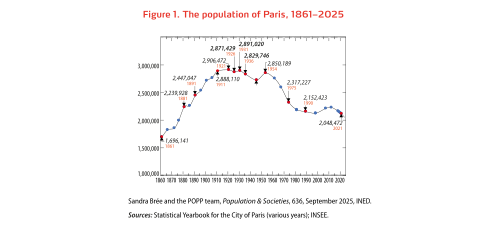
Between 1881 and 1911, births slightly outnumbered deaths. However, this very low rate of natural population increase only partly explains the growth of the Parisian population, which was heavily impacted by the arrival of people born elsewhere. There was a slight boom in births just after World War I, followed by a sharp decline, but the birth rate remained higher than the death rate until 1933. Could Paris’s population have remained stable without migration? This is unlikely since the new arrivals were young, of reproductive age, and contributed to the capital’s birth rate. Conversely, those who left the capital were older, died elsewhere, and did not, therefore, contribute to its mortality rate.
1.2. Two-thirds of Parisians were not born in the capital
Since the 18th century, the majority of Parisians have not been born in the city. During the interwar period, in 1926, only one-third of its population was born there. This remains the case nearly 100 years later: by 2020, the proportion of Parisians by birth had even declined slightly, lying at 29.7%. In 1926, as now, the residents of the French capital were much less likely to have been born in their department (département) of residence than were people living in other departments, testament to Paris’s appeal [4]. The population of Paris was therefore composed primarily of people born elsewhere in France or abroad; and even more so today, with 25% of Parisian residents having been born abroad and 45% in another department, much higher rates than in the rest of France.
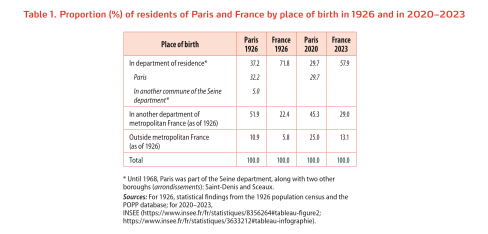
During the interwar period, women were more likely to have been born in metropolitan France (52%–55%, depending on the year) than men (45%–48%), who were more likely to be from departments within Algeria, from French colonies and protectorates, or from abroad (14%–15% vs. 9% for women). At that time, the distribution of departments of birth was virtually the same as in the late 19th century [5]: they were mainly situated in the northern half of France, within a catchment area of approximately 200 km surrounding the capital. The proximity of these departments of birth echoes the geographical origin of the new arrivals, although some also came from further afield, such as Brittany, Burgundy, Auvergne, or Limousin. The majority of moves were motivated by work and were linked to labour requirements after World War I, but were also, in the interwar period, associated with the attraction held by Paris’s cultural and artistic development or the promise of asylum: Russians seeking exile following the 1917 revolution, Armenians trying to escape genocide, or Jews fleeing from discrimination and pogroms.
Country of birth does not fully overlap with nationality. A person can acquire French nationality (naturalization) or be born with French nationality abroad if one or both of their parents are French. During the interwar period, 7% of women and 12% of men living in Paris had foreign nationality, and 2% of individuals (both sexes) were naturalized. These are higher rates than during the preceding period. Between 1881 and 1911, 7% of residents (both sexes) were foreigners, and less than 2% of individuals were naturalized in 1911. Today, 15% hold foreign nationality. Between 1926 and 1936, the proportion of foreigners fell as the rates of naturalized individuals rose, due to the application of the Law of August 1927 which relaxed the criteria for naturalization. Among foreign nationals, the majority were Italian, Polish, Russian, or Belgian.
1.3. A population with many women and young adults
The population pyramid for Paris in 1926 took the form of a Christmas tree, as it had done since the 19th century. The narrow base is explained by the low numbers of children. Not only was the fertility rate very low, some infants were sent ‘away’ to wet nurses, although this practice was less commonplace than previously [6]. Last, while infant mortality across France and in the capital was falling, it was still 89 per 1,000 among baby girls and 106 per 1,000 among baby boys2 in 1926, and 58 per 1,000 and 74 per 1,000, respectively, in 1936.
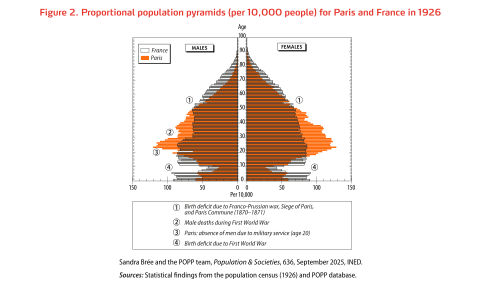
On the other hand, there were large numbers of adults of working age, particularly aged 25–45, due to significant migration. The population aged 50 and over was declining, primarily due to increasing mortality with age, but also to departures from the city. Some people left Paris to return to their region or country of origin, or to move to the suburbs or beyond.
The population of Paris was made up of more women than men (55% vs. 45%), more than the French population as a whole (52% women). Like elsewhere, there were more males than females at birth and, to a lesser extent, during childhood, with women in the majority from adolescence onwards and particularly over the age of 55. Mortality in Paris was higher than the French average at all ages, with urban living conditions being worse due to overcrowding, among other things. However, the mortality gap between Paris and the rest of France was particularly wide among men aged 40 and over.
Furthermore, several notable events give the Parisian pyramid its specific shape in the interwar period: the birth deficit and male deaths caused by World War I (also observed for the rest of the French population); the birth deficit due to the Franco-Prussian War in 1870 (also visible on the pyramid for France) during the siege of Paris (September 1870 to January 1871); and the Paris Commune several months later, these latter two events being specifically Paris-focused. Today, the differences between the population pyramids of Paris and France as a whole are less distinct. The base of the Paris pyramid is still narrower, since the proportion of children living in Paris is lower. Adults, on the other hand, are slightly more numerous, while there are slightly fewer older people.
1.4. Large numbers of single people
One specific characteristic of the Parisian population was the large number of single (never married) people among the population aged 15 and over (Figure 3). Proportionately, there were many more single people in Paris than in France on average. This relates to the age structure of the Parisian population pyramid and particularly to the arrival of young people, many of whom were single. Conversely, married people were proportionately less common in Paris than across the country as a whole. Cohabitation (concubinage)3 was, on the other hand, more common in Paris compared with the national average, but the gap had narrowed since the late 19th century.
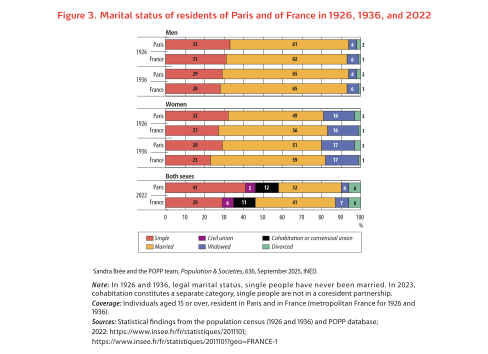
In Paris, as elsewhere, there were more widows than widowers due to greater life expectancy among women and age gaps between spouses, with men often being the older member of a couple. During the interwar period, widows were common due to the loss of men during World War I, even though some of these widows remarried. However, while the numbers of widows was similar, there were far few widowers in Paris than in the rest of France. This may have been because widowers (and divorced men) were even more likely to remarry than widows (and divorced women) in Paris than elsewhere.
The divorced population in the capital was higher than across the country as a whole, as had been the case since the late 19th century. In 1936, in Paris, 2% of men and more than 3% of women were divorced, versus less than 1% of the rest of the French population. New or marginal behaviours (not only separation but also birth control, births outside marriage, same-sex relationships, etc.) were more frequent in Paris due to the anonymity provided by a large city and separation from community and family structures.
Today, the marital statuses of Parisian men and women remain different from the French average. Paris has more single people than the rest of France and fewer married and widowed people. On the other hand, unlike in previous centuries, there are relatively fewer divorced people in the capital, while unmarried couples are as prevalent in Paris as in the rest of France (though cohabitation and consensual union are more popular and civil unions less so in Paris).
1.5. A socially differentiated city
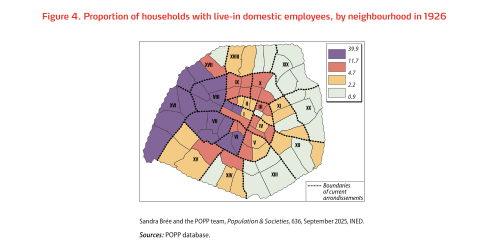
Just like today, the various neighbourhoods (quartiers) of Paris had distinctive characteristics in the interwar period, with clear social, professional, and cultural differences. The number of domestic workers per household is a good indicator of the wealth of a neighbourhood. The employment of domestic workers, which was particularly common in western areas of Paris, reveals that the 7th, 8th, and 16th arrondissements, as well as the south of the 17th, were the wealthiest, while those in the east, particularly on the outskirts of the city, were the poorest. While many households, even those that were not particularly well off, had a housekeeper, the wealthiest were able to employ a range of domestic workers (butler, cook, valet, governess, driver, etc.), and there were sometimes more employees in a household than there were family members. However, in the interwar period, the number of domestic employees was in decline, and the single housekeeper setup was gradually becoming even more prevalent. Domestic employees, 85% of whom were women, were also becoming less likely to live with their employers, increasingly having their own home.
This geographical segregation of the city space still exists, testament to the persistence of this dichotomy. The west of the capital is still home to the wealthiest and the east to the poorest households.4
1.5.1. Box 1. Paris censuses and the POPP project
From the early 19th century, Paris, like every French commune, conducted a census every 5 years to record the size and composition of its population, and published statistics from it. However, unlike other communes, the capital did not produce any resident registers until 1926 [2], and then again in 1931, 1936, and 1946 (all stored in the Paris Archives). The first three registers, which correspond to the interwar period, have been digitized and compiled into databases as part of the POPP project (Projet d’océrisation des recensements de la population parisienne).
This project, bringing together a team of computer scientists [3] and social science researchers, aimed to create a historical population database using artificial intelligence tools and deep learning resources, including optical character recognition.
The POPP database will soon be available on a data diffusion portal (Progedo Diffusion*) and will shed light on a range of urban population characteristics in the early 20th century: household structure, occupational structure, geographical distribution within the city, sex, age, place of birth, and nationality. It has also been provided to the Paris Archives to enable searches by name within the digital images of the population censuses from 1926, 1931, and 1936. Online searches by name will be possible from October 2025, as part of the The People of Paris (1926–1936) exhibition and on the archives’ website** (see Box 2).
The POPP project has received funding from CollEx-Persée (2020–2022), as well as from GED-Campus Condorcet, Progedo, and the CNRS. For further information about the project, the team, and the latest developments, visit: https://popp.hypotheses.org
1.5.1. Box 2. The People of Paris (1926–1936): Reflections from Population Censuses
This exhibition, under the French title Les gens de Paris (1926–1936). Dans le miroir des recensements de population, will be held at the Musée Carnavalet (Museum of Paris History) from 8 October 2025 to 8 February 2026. It will situate data from the 1926, 1931, and 1936 censuses within a broader context, drawing on over 200 artistic and literary works: paintings, photographs, models, sculptures, drawings, signs, medals, objects, posters, prints, and books, as well as films and audio recordings. These fragments of life give us an insight into the daily lives of Parisian men and women 100 years ago. Layer by layer, their individual, marital, family, and professional trajectories paint a portrait of a city in transformation [7].
Exhibition website (in French): https://www.carnavalet.paris.fr/expositions/les-gens-de-paris-1926-1936
Appendix A References
- [1] Chevalier L. 1950. La formation de la population parisienne au XIXe siècle. Puf.
- [2] Brée S. 2015. La population de la région parisienneau XIXe siècle [Working Paper]. DEMO, 6. https://shs.hal.science/halshs-01624749
- [3] Constum T., Kempf N., Paquet T., Tranouez P., Chatelain C., Brée S., Merveille F. 2022. Recognition and information extraction in historical handwritten tables: Toward understanding early 20th-century Paris census. In Uchida S., Barney E., Eglin V. (eds.) Document analysis systems. DAS 2022. Lecture notes in computer science (Vol. 13237, pp. 143–157). Springer. https://doi.org/10.1007/978-3-031-06555-2_10
- [4] Batije M., Dubuje F. 2025. Où les Parisiens sont-ils nés ? Insee Analyses Île-de-France, 197. https://www.insee.fr/fr/statistiques/8356264
- [5] Pinol J.-L., Garden M. 2009. Atlas des Parisiens. De la Révolution à nos jours : population, territoire et habitat, production et services, religion, culture, loisirs. Parigramme.
- [6] Rollet C. 1982. Nourrices et nourrissons dans le département de la Seine et en France de 1880 à 1940. Population, 37(3), 573–604. https://www.persee.fr/doc/pop_0032-4663_1982_num_37_3_17360
- [7] Brée S., Ducaté H., Guillaume V. 2025. Les gens de Paris (1926-1936). Dans le miroir des recensements de population [Exhibition catalogue], Musée Carnavalet-Histoire de Paris, Paris-Musées.
Data for the tables and figures are available in Excel format in the ‘Related documents’ tab on INED’s web page for Population & Societies
Infant mortality is likely to have been underestimated as a proportion of the number of births in Paris, given that some children left the capital and their deaths were registered elsewhere.
Cohabitation is estimated from household situations but was not recorded in official statistics as would be the case today (Figure 3). It was a status primarily used to describe not only the living situations of single people but also those of widows and widowers, divorcees, and even married people.
Author(s)
Sandra Brée - Laboratoire de recherche historique Rhône-Alpes (Larhra), CNRS
The POPP team - Thierry Paquet (laboratoire d’informatique, du traitement de l’information et des Systèmes – Litis, université de Rouen), Pierrick Tranouez (Litis, université de Rouen), Thomas Constum (Litis, université de Rouen), Nicolas Kempf (Litis, université de Rouen), François Merveille (Humathèque), Victor Gay (Toulouse school of economics, université Toulouse Capitole), Marion Leturcq (Ined), Yoann Doignon (CNRS, Idées), Baptiste Coulmont (ENS Paris-Saclay), Mariia Buidze (CNRS, Progedo), Jean-Luc Pinol (ENS Lyon, Larhra)