
In France and Europe, why does the population grow despite more deaths?
In 2025, France recorded more deaths than births for the first time since the Second World War. Yet the population continues to grow, as elsewhere in Europe. The reason: positive net migration offsets the natural decrease.
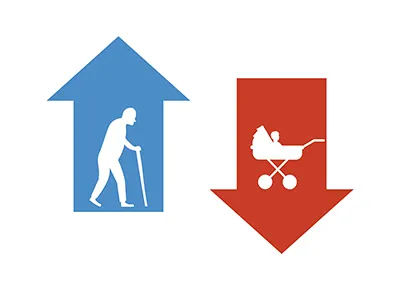
In France, there are now more deaths than births
On 1 January 2026, France had 69.1 million inhabitants. In 2025, the population grew by 0.25%, but deaths were more numerous than births. Natural change, the difference between births and deaths, was negative for the first time since the end of the Second World War: –6,000 in 2025, compared with +205,000 in 2015. This trend is mainly due to a decline in births, a decline which accounts for around three-quarters of the country’s decrease in natural change.
The number of deaths will increase as the population ages
The 651,000 deaths observed in 2025 represent a 1.2% increase compared to 2024 and is principally due to the ageing population. The large baby-boom generations (1946–1974) are ageing and are gradually reaching the ages associated with high mortality rates. Although life expectancy continues to rise (80.3 years for men and 85.9 years for women in 2025), the annual number of deaths is expected to continue to rise over the coming decades.
Births decline as age at motherhood increases
At the same time, the number of annual births in France is declining, with 661,000 in 2024 and 645,000 in 2025. The total fertility rate stands at 1.56 children per woman in 2025, down from 1.61 the previous year. The trend towards having children later in life is continuing: the average age at childbirth is now 31.2 years, compared with 26.5 years in the late 1970s.
The growth of the French population now depends on migration
Despite this natural deficit, the French population continues to grow thanks to positive net migration, meaning that the number of people entering the country exceeds the number leaving. This net migration, estimated at +176,000 in 2025, more than compensates for the excess of deaths over births and explains the population increase observed this year. Based on current trends, net migration is expected to continue to play a decisive role in population growth.
A development already at work in the European Union
Throughout the European Union, deaths have outnumbered births since 2012. In 2024, 3.56 million births were observed in the EU compared to 4.82 million deaths; that is, an excess of 1.26 million deaths. And yet the European population increased by 9 million inhabitants between 2012 and 2025, rising from 441 to 450 million. As in France, this growth is attributable to positive net migration
Migration will play a decisive role in the long term
Eurostat projections show that, by 2050, the number of deaths will exceed the number of births by nearly 2 million per year in the European Union. As a result, migration is expected to remain a decisive factor in demographic trends.
Key figures
- 69.1 million inhabitants in France as of 1 January 2026
- 651,000 deaths and 645,000 births in France in 2025
- Natural change: –6,000 in 2025 in France (compared with +205,000 in 2015)
- Estimated net migration: +176,000 in 2025 (surplus of people entering vs. leaving the territory)
- 1.56 child/woman in France in 2025
- 80.3 years life expectancy for men and 85.9 years for women in France in 2025
- 450 million inhabitants in the European Union
- 1.26 million more deaths than births in the EU in 2024
Referens
Population & Societies no. 642, March 2026, entitled: “In France, as in Europe as a whole, net migration offsets the excess of deaths over births”