Achille Guillard

Not only did he coin the word “demography” …

Les éditions de l'Ined

After studying literature at the lycée [now the French equivalent of high school, but highly selective before the nineteenth century] of the city of Clermont-Ferrand, Achille Guillard (1799-1876) taught secondary school at the collège [middle school] of Saint-Chamond. He was interested in theology, but later shifted to science studies. Guillard studied with the French botanist Nicolas Charles Seringe and defended his doctoral thesis in 1835. After becoming a botanist himself, he completed the work he had begun in his thesis on “inflorescence” or the flowering process, specifically, how branches and flowers develop within plants, demonstrating that the process unfolded in the same order in every species and obeyed fixed laws. Guillard later became connected to the renowned Bertillon family when his daughter Zoé married the physician, statistician, and anthropologist Louis-Adolphe Bertillon. Another of Guillard’s daughters married the economist and historian Gustave Hubbard. Zoé and Louis-Adolphe Bertillon were the parents of Alphonse and Jacques, who both became important men, especially Alphonse, who applied anthropometry to law enforcement. 

A new word for a new science? 

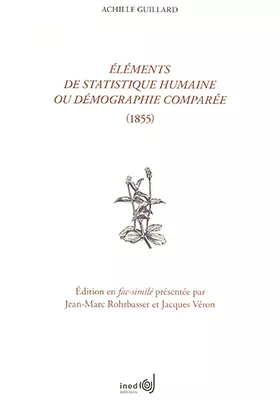
Guillard’s greatest ambition was to provide a definition for population studies, a scientific field that he deemed central to any investigation of societies. He gave it the name “demography,” and defined it as “knowledge acquired through observation of the laws in accordance with which populations form, maintain, and renew themselves and succeed one another.” In the very opening of his Éléments de Statistique Humaine and Démographie Comparée, both published in 1855, Guillard presents his extremely broad notion of population science: it purports to “take care of men [people], their as yet precarious state, their yet contested advancement, the physiological laws that govern them, the social laws that should govern them, the economy of human strengths (in theory) and their dissipation (a matter of fact), liberty and servitude, the obligation to work and the deserved rest from work, wellbeing through heredity, poverty due to ignorance, birth and death, money and bloodlines, agriculture, commerce, government, industry, and a few other Gehennas [a biblical reference which may be defined in the plural as causes of suffering].”

The “law of population”

According to Guillard, the focus of demographic research was the “law of population,” which he defined as “the law or set of laws under which humanity accomplishes its progress, first by way of quantity [population increase], then through instruction, morality, vigor, wellbeing.” As he saw it, three variables—population, means of subsistence, and labor—were central to that law due to the links between them: population, subsistence, and labor were the substance of human life itself. Guillard was vehemently opposed to Malthus and his population principle, arguing instead in favor of the enduring balance notion, because “the population grows in accordance with the means of subsistence.” For him, the “subsistence equation” was the genuine foundation of his law of population: “[The average population] P is proportionate to the available means of subsistence.” By subsistence he meant the general conditions of existence, which included both “food and drink, clothing, lodging, and the very air one breathes,” and “moral conditions,” among which figured “virtue, the joy that comes of performing good actions, the security due to public order as applied to freedom.” His training as a naturalist, his personality, his worshipful attitude toward science, his positivist spirit and republican commitment explain why Achille Guillard was an important figure of nineteenth-century social science.