
The mental burden involved in household activities
Parenting activities and household tasks can constitute a mental burden linked to a risk of depression—one that usually concerns women, regardless of their family or work situations.

Mental burden exposes to a risk of depression
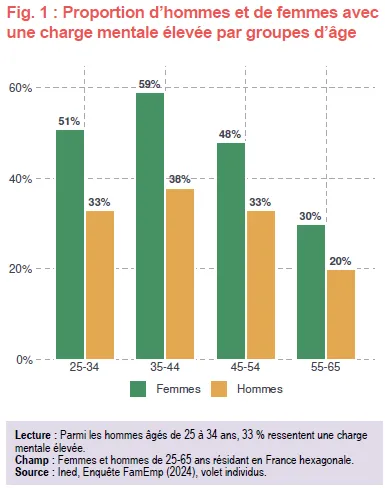
In both the private and work spheres, having a considerable number of activities to carry out every day may make people feel under uncomfortable time pressure or that they have to think about too many things at once. The term used for this experience in the work sphere is organizational tension, and when it persists it has been found to be a factor of poor health, specifically poor mental health. In the framework of family and domestic work, a term often used is mental burden. In its most intense form (see Definitions), mental burden affects 46% of women and 30% of men aged 25 to 65 in France. Though it is found for all ages (Fig. 1), it is more widespread in people aged 35 to 44, particularly women (59%); the figure falls sharply after age 55. Like organizational tension at work, household-related mental burden is linked to poor health (Fig. 2): the risk of depression—already higher on average for women (15% versus 11% for men)—rises among people who report heavy mental burden (19% of women; 16% of men).
Mental burden varies by family situation and job
Parenting responsibilities, represented in the survey by the fact of living with a child under age 15 (cf. Definitions below), involves mental burden for over 60% of women and 40% of men, regardless of whether they are also assisting a disabled adult. People who do care for an adult and who do not or no longer have parental responsibilities are more likely to report mental burden. And it diminishes still further for persons with neither type of responsibility, while remaining a source of tension for 36% of women and 25% of men—a finding that suggests the existence of activities not measured here (involving older children or non-disabled relatives, leisure activities, or participation in an association, for example).
For women, having a job increases the probability of experiencing heavy mental burden, whereas this is only the case for men without parental responsibilities
The effect of being in a couple varies by sex and whether one is working. For working men, being in a couple increases the probability of experiencing mental burden while reducing it for unemployed men. For women taking care of a child under 15, being in a couple has little effect on the probability of reporting heavy mental burden. But among working women without parental responsibilities and not assisting an adult relative, heavy mental burden is reported by 41% of women with a life partner as against 34% without one. Altogether, mental burden is more frequently found among women, regardless of family and work situations—a result that would seem to be explained by the greater average quantity of domestic and parenting activities falling to them (including for women not discussed here) (cf. Pages 12 and 15).
Definition
Heavy mental burden is measured here by the fact of “often feeling under time pressure” and having to “think often or all the time about too many things at once in one’s personal and family life.”
Depression risk is measured using the World Health Organization’s WHO-5 Health Score, based on a list of 5 emotional states. The threshold applied here is 32/100. Parenting responsibility is assumed for people living at least half of every week with a child under 15.
Caregivers are people who report taking care of a disabled adult (spouse or parent) at least once a week.


Referens
Authors: Constance BEAUFILS and Emmanuelle CAMBOIS
Complete list of the 62 data sheets from the Famemp survey [FR]