
Life expectancy in Paris since the late nineteenth century
Paris was once marked by persistent high mortality. In the late 19th century, the French capital lagged significantly behind the rest of the country in life expectancy. Yet today it ranks among the places in the world where people live the longest. What explains this spectacular turnaround?

A dive into the city’s historical health records works to reveal the key drivers of this transformation, which included a fall in infectious disease, public hygiene improvements, and a sharp decline in mortality-related social inequalities.
In a recent study published in Population and Development Review, researchers Florian Bonnet, Catalina Torres, Lionel Kesztenbaum, and France Meslé compiled an entirely new dataset on cause-specific mortality in Paris between 1890 and 1949, thereby producing an entirely new resource now on open access for the scientific community.
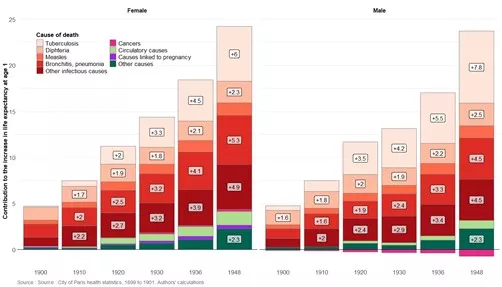
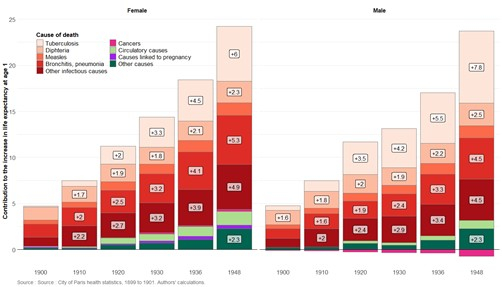
What did they find? A gradual decline in infectious disease alone accounts for almost 80% of the total life expectancy gains over the period. Of the 25 years gained, 20 were due to this decline in infections. The fight against tuberculosis was the main driver of this substantial improvement (Figure 2). Cardiovascular diseases and cancers, on the other hand, played no more than a minor role before 1950.
Note: Positive contributions (above 0) indicate gains in life expectancy compared with 1891. Negative contributions (below 0) indicate losses in life expectancy relative to 1891.
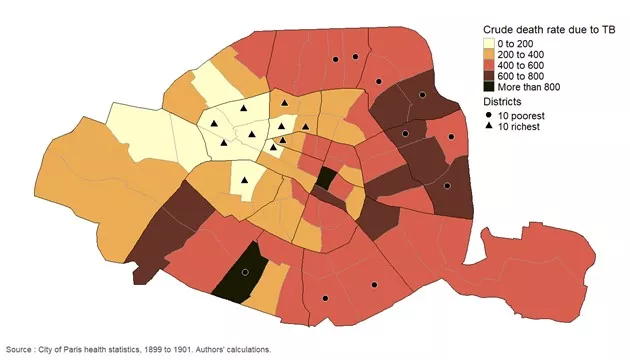
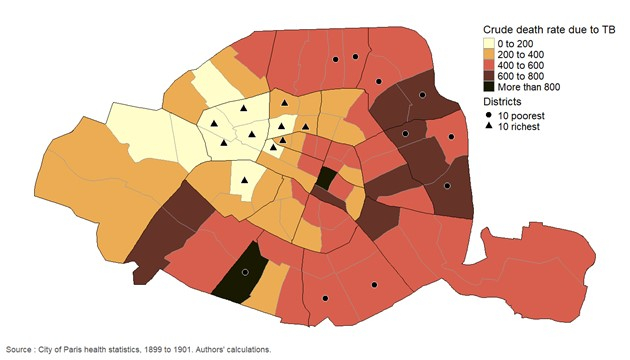
Moreover, mortality rates were found to differ considerably by city neighborhood, reflecting the social inequalities of the time. A stark contrast is observed between wealthy central-western Paris and working-class Paris on the eastern edge of the city, a social faultline that can be seen clearly on the map of mortality due to tuberculosis (Figure 3).
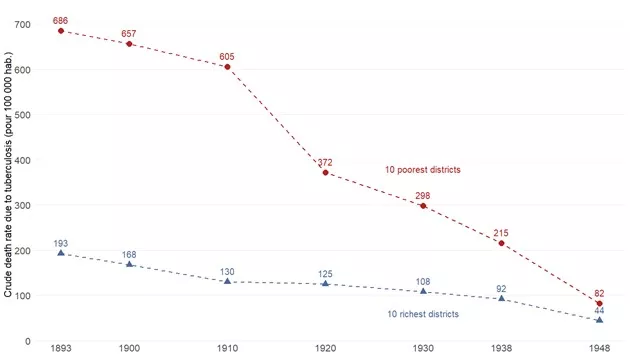
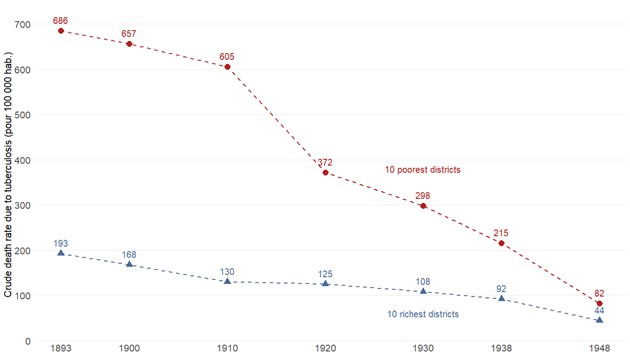
Those inequalities were at their widest just before the First World War, when mortality in the ten poorest Paris neighborhoods was four times that in the city’s ten richest ones. By the end of the Second World War these inequalities had greatly receded (Figure 4).

What caused the sharp fall in mortality? The authors put forward several possible explanations: investment in sanitation infrastructure, medical advances, and economic and social change.
They now plan to do an overall analysis of a considerably longer period, stretching from 1872 to 2019, to understand the general dynamics of life expectancy expansion in Paris.