
Having a child outside a cohabiting union: A common situation in Overseas France

Abstract
Lone-parent families are twice as common in the overseas departments and regions of France (départements et régions d’outre-mer, DROMs) as in metropolitan France. They often arise due to the birth of a child outside of a cohabiting partnership. More than a third of women in the DROMs born between 1941 and 1980 had their first child when they were not living with a partner. These births took place at earlier ages and were more common among less educated mothers and those from deprived backgrounds. They were often followed by other births outside of a cohabiting partnership.
Article
Institut national d’études démographiques (INED), F-93300 Aubervilliers, France
Lone-parent families are twice as common in the overseas departments and regions of France (départements et régions d’outre-mer, DROMs) as in metropolitan France. They often arise due to the birth of a child outside of a cohabiting partnership. More than a third of women in the DROMs born between 1941 and 1980 had their first child when they were not living with a partner. These births took place at earlier ages and were more common among less educated mothers and those from deprived backgrounds. They were often followed by other births outside of a cohabiting partnership.
lone-parent family, parenthood, single mother, lone parent, Overseas France, DROM
Table of contents
- Appendix A References
1.
The number of lone-parent families is rising. Most of these families exist as the result of a separation. In some circumstances, a child is born to a mother who is not living with a partner. This situation is much more common in Overseas France than in metropolitan France. Arnaud Régnier-Loilier describes the characteristics of these parents who are not living with a partner at the time of the birth of their first child and traces their partnership and fertility trajectories.1
In 2023, the fertility rate in the French Antilles was close to the rate recorded in metropolitan France (1.66 children per woman in Martinique and 1.88 in Guadeloupe, compared with 1.64 in metropolitan France), slightly higher in Réunion (2.5), and higher still in French Guiana (3.3). Family configurations in the overseas departments and regions of France (départements et régions d’outre-mer, or DROMs) are different from those in metropolitan France, with a higher proportion of lone-parent families (one parent raising their children alone) resulting from specific sets of circumstances.
1.1. In Overseas France, nearly 1 family in 2 is a lone-parent family
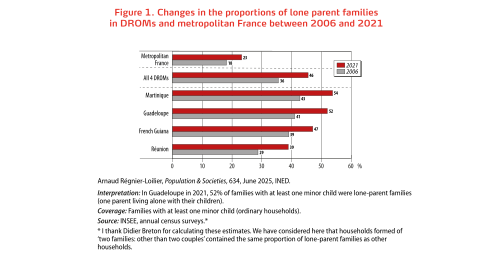
Among families with at least one minor child, the proportion of lone-parent families is twice as high in the DROMs as in metropolitan France (46% vs. 23% as of 2021). Significant variations arise between the overseas territories (Figure 1), as well as between departments of metropolitan France.2 In the French Antilles, more than 1 family in 2 is a lone-parent family (54% in Martinique, 52% in Guadeloupe). Lone-parent families represent 47% of families in French Guiana and 39% in Réunion. Lone-parent families in the DROMs are also slightly more likely to be composed of a mother raising her child or children alone than is the case in metropolitan France (more than 9 out of 10 cases vs. 8 out of 10 cases), rather than of a father living with his children.
Between 2006 and 2021, the proportions of lone-parent families in metropolitan France and the DROMs continued to rise at similar rates (+27%). However, the increase was higher in Réunion (+35%) and lower in French Guiana (+21%).
1.2. In the DROMs, first births occur outside a cohabiting union
While in metropolitan France, lone parenthood generally occurs following separation, different scenarios play out in the DROMs, as evidenced by the Migrations, Family, and Ageing survey (see Box 1). Births outside of a cohabiting partnership3 are much more common in the DROMs: 44% of women who gave birth in 2021 did so without cohabiting with a partner.
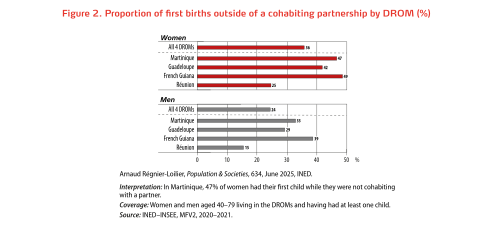
In the DROMs, more than 1 in 3 women (36%) born between 1941 and 1980 had their first child without cohabiting with a partner (Figure 2) and even before any experience of living with a partner (only 3% of these women had lived with a partner previously). This proportion is highest in French Guiana (49%), in the Antilles slightly lower, and lowest in Réunion (25%). The proportion of first births occurring outside a cohabiting union was consistent between the 1951–1960 and 1971–1980 generations in the Antilles and increased slightly in Réunion (from 23% to 27%).
Men were less likely than women to report having had their first child outside of a cohabiting partnership (Figure 2). Some of them may not have been told about the pregnancy at all, others might not have mentioned the child in the survey if they had never lived with the child or been involved in their upbringing, and still others may have had the child while cohabiting with a different partner.4 In the DROMs, many children are not formally recognized by their fathers at the civil registry (which does not necessarily signify the absence of any connections between them), and the child’s surname is much more likely to be the mother’s surname only (39%5 vs. 5% in metropolitan France in 2023). The high proportion of first births outside of a partnership is linked to partnership trajectories in the DROMs, where, at a given age, cohabiting with a partner is less common in the Antilles, French Guiana, and (to a lesser degree) Réunion than in metropolitan France.
1.3. Births outside of a cohabiting partnership occur earlier
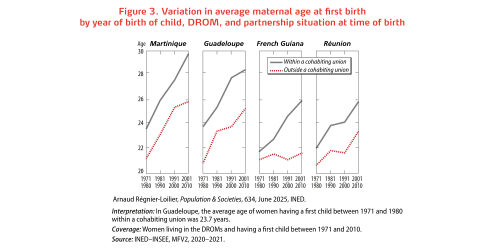
Births outside of a cohabiting partnership occur at much earlier parental ages than those within such partnerships. Half of mothers born between 1941 and 1981 living in the DROMs whose first child was born outside of a partnership had that child before the age of 22. For those living with a partner, this median age is around 25. For fathers, the median ages are 25 and 28, respectively. The rate of adolescent births, occurring before the maternal age of 18, is 3 times higher among births outside of a partnership (17%) than among births to a cohabiting couple (5%). While in French Guiana adolescent motherhood is generally more frequent (16% of first births occur before the age of 18), the rate is particularly high among births outside of a partnership (23%). Adolescent motherhood is rarer in Réunion (8%), Martinique (8%), and Guadeloupe (9%). However, it is in the Antilles that the contrast between the timings of first births outside and within partnerships is the most striking: in Martinique, 15% of births outside partnership take place during adolescence versus 2% of those within a partnership; these proportions are 18% and 3%, respectively, in Guadeloupe.
In general, as in metropolitan France, age at first child in the DROMs is increasing. If we consider the first births that took place between 1971 and 2020, whether within a couple or not, maternal age has strongly increased in the Antilles and, to a lesser degree, in Réunion (Figure 3). In French Guiana, this trend only applies to births occurring within a cohabiting couple, with the average age at first birth outside a cohabiting union remaining stable. The profile of mothers having a first child without living with a partner is, in contrast, increasingly specific in terms of maternal age.
As they take place much earlier, births outside of a cohabiting partnership more often occur when the father or mother is still living with their parents. This is the situation for 42% of these mothers and 37% of these fathers. As lone-parent families are almost always formed of a mother and her children, it is especially the mother’s family that is called upon to help and to welcome a grandchild under their roof.
In French Guiana, however, men whose first child is born outside of a union are more likely to have left the family home already than in the other three DROMs. This is explained by the high proportion of immigrant men (nearly one-quarter of 18- to 79-year-old men were born abroad [2]),6 often having left the parental home sooner than natives in order to migrate. But it is also more common for a couple to have had their first child while still living with their parents. So-called complex households, in which at least three generations are living together, are commonplace (17% of Guianese households in 2020), although they are becoming less so [3].
1.4. Becoming a parent outside of a cohabiting partnership is more common among less educated mothers
In the DROMs, individuals with one or more parents holding an executive-level job or higher intellectual occupation are less likely to have a first child outside of a partnership (13% of men and 17% of women) than average (24% and 36%). Correspondingly, women who have faced major financial difficulties during their youth (before age 18) are more likely to have had a first child outside of a partnership (41% of women vs. 33% in the absence of financial difficulties), though this difference is not significant among men (Figure 4).
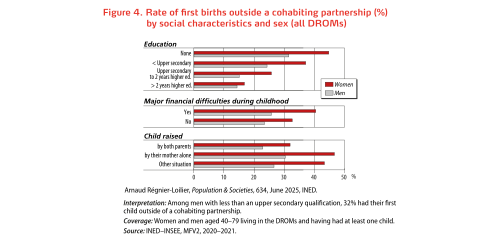
Educational level is also linked, and even more closely, to partnership situation at time of birth, particularly among women: 45% of mothers with less than an upper secondary qualification had their first child outside of a cohabiting partnership versus 17% of women with at least 2 years of higher education found themselves in the same situation. This contrast is equally strong across the DROMs and is caused by two factors. First, lack of education, more common among the least advantaged social groups, reduces employment options. Becoming a parent may then represent another way of defining oneself socially [4]. Secondly, the birth of a child outside of a partnership, which, on average, occurs at an earlier age and sometimes during education, may cause studies to be interrupted. This is the case for 11% of women whose first child is born outside of a cohabiting partnership versus 4% if the child is born within a partnership, a similar proportion across all four DROMs.
Finally, not having spent one’s childhood (up to the age of 15) with both parents (a situation that applies to around 3 in 10 people in the Antilles and French Guiana and to 2 in 10 in Réunion), which usually reflects having been raised by one’s mother alone, goes together with a greater propensity among women to have a first child outside of a partnership (47% vs. 32% of those raised by both parents).
1.5. Having a second child without a partner is much more common if the first birth was outside of a partnership
The second child is usually born within a cohabiting union. While 35% of mothers (aged 40–79) with at least two children had their first outside of a partnership, only 25% had their second child without a partner. For men, the proportions are 25% and 15%, respectively. In French Guiana, the department in which rates of first births outside partnership are highest, rates of second births outside partnership are also the highest, with the inverse being true for Réunion.
Relationship situations at first and second childbirth are connected. It is very common for the second child to be born outside partnership if the first was: this is true among 67% of mothers who had their first child outside partnership and 53% of fathers. Conversely, it is very rare for the second child to be born outside partnership if the first was not (3% of mothers in a partnership at first childbirth and 2% of fathers). This trend is found across all departments, outlining fertility trajectories that occur completely outside of any cohabiting relationship framework. However, the survey does not indicate whether both children born outside a cohabiting partnership have the same parents.
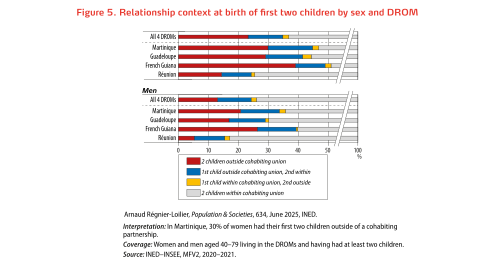
By combining relationship situations at first and second births, four scenarios emerge: (a) both children are born within a cohabiting partnership (68% of cases, both sexes); (b) both are born outside of a cohabiting partnership (19%); (c) the first child is born outside of a cohabiting partnership and the second within one (12%); and (d) the first child is born within a cohabiting partnership, but the second child is not (2%) (Figure 5).
The first scenario mainly applies to men (74% have both children within a partnership vs. 63% of women),7 with women being more likely to have both children outside of a partnership (23% vs. 13% of men). This scenario, in which both children are born outside of a partnership, is much more common in French Guiana (39% of women and 27% of men) and, conversely, rarer in Réunion (15% and 5%, respectively), which corresponds with the frequency of first births outside partnership for each department. However, prevalence is similar across the DROMs for scenarios characterized by entering a partnership between the first and second child (around 12%, irrespective of department or sex) or by a separation followed by a second birth outside partnership (between 1% and 2%).
***
The factors associated with lone parenthood are not the same across France, within the DROMs, or across different social groups. This diversity suggests that the existence of uniform fertility norms at the national level should be qualified. A double model of fertility and family behaviours emerges in the DROMs: the first, similar to that of metropolitan France where living as a cohabiting couple appears to be a prerequisite to starting a family; the second, characterized by entering parenthood via lone parenthood. We might wonder to what extent these pregnancies are planned or unplanned, or whether they reflect multiple aspirations in terms of family forms and gender relations: a quest for social identity through motherhood, the desire to escape situations of domestic violence, or even, as in the Antilles, the omnipresence of the potomitan woman, the central pillar of the family, in a context where matrifocality is still very prevalent and where it is common for a man to have several partners at the same time [5]. Lone parenthood, usually involving the mother and occurring from the birth of her first child, is accompanied by significant material insecurity. The proportion of lone-parent families in situations of extreme poverty(7) is 17% in Guadeloupe and Martinique, 24% in Réunion, and as high as 32% in French Guiana, compared with 5% in metropolitan France. Better deciphering the rationales behind lone parenthood remains an important social challenge and requires more detailed investigation of the phenomenon.
1.5.1. Box 1. The Migrations, Family, and Ageing survey
The Migrations, Family, and Ageing survey (MFV2) was conducted by INED and INSEE (the French statistics office) between 2020 and 2021 in the Antilles, French Guiana, and Réunion, among 11,342 people aged 18–79 living in ordinary households: 2,734 in Martinique, 3,005 in Guadeloupe, 2,688 in Guiana, and 2,915 in Réunion (for more details, see: https://mfv2.site.ined.fr).
MFV2 describes childbearing periods and periods of cohabiting partnerships of at least 3 months. Here, we consider a child to be born outside of a cohabiting partnership if their year of birth is prior to the start year of the cohabiting relationship or subsequent to the end year of the relationship. This does not mean that the birth occurred in the absence of a couple relationship, which may be non-cohabiting (these relationships are not described retrospectively). If the cohabiting partnership was formed in the year of the birth, this birth is considered as having taken place within a couple.
This study focuses on 40- to 79-year-olds (the generations between 1941 and 1980), i.e. individuals who have almost completed their reproductive lives (only 1% of women and 5% of men from the 1956–1965 generations had a first child between the ages of 40 and 55).
MFV2 benefitted from financial support from the ANR (iPOPs, ANR-10-LABX-0089-013), the Directorate-General for Overseas France (DGOM), the French Institute for Youth and Popular Education (INJEP), and regional and departmental funding.
Appendix A References
- [1] Cinelli H., Lelong N., Le Ray C. and ENP2021 Study group. 2022. French national perinatal survey 2021: Births, 2-month follow-up and establishments. Situation and trends since 2016. Inserm. https://www.santepubliquefrance.fr/docs/enquete-nationale-perinatale.-rapport-2021.-les-naissances-le-suivi-a-deux-mois-et-les-etablissements
- [2] Breton D., Marie C.-V., Floury É., Crouzet M., Lottin A., Bilionière M., Salibekyan-Rosain Z. 2023. Migrations, famille et vieillissement en Guyane : Premiers résultats de l’enquête MFV-2. INED. https://www.ined.fr/fichier/s_rubrique/34297/brochure_mfv_guyane_04.12.fr.pdf
- [3] Daguet F., Pora P. 2024. Partager son logement au-delà du noyau familial : des disparités régionales qui persistent. Insee Première, 1980. https://www.insee.fr/fr/statistiques/7749698
- [4] Marie C.-V., Breton D. 2015. Les « modèles familiaux » dans les Dom : entre bouleversements et permanence. Ce que nous apprend l’enquête Migrations, famille et vieillissement. Politiques sociales et familiales, 119, 55–64. https://doi.org/10.3406/caf.2015.3075
- [5] Lefaucheur N. 2014. Situation des femmes, pluripartenariat et violences conjugales aux Antilles. Informations sociales, 186, 28–35. https://doi.org/10.3917/inso.186.0028
- [6] Audoux L., Prévot P. 2022. La grande pauvreté bien plus fréquente et beaucoup plus intense dans les DOM. Insee Focus, 270. https://www.insee.fr/fr/statistiques/6459395#onglet-3
(1) Data for the tables and figures are available in Excel format in the ‘Related documents’ tab on INED’s web page for Population & Societies.
The proportion of children living in lone-parent families varies between departments by up to a factor of two (from 14% to 28%): https://www.insee.fr/fr/statistiques/4285341#tableau-figure5_radio2
In this article, the terms partnership and union are used interchangeably, both referring to couple relationships that involve cohabitation (see Box 1).
By design, the birth is then counted in the survey as having taken place within a partnership.
57% in Guadeloupe, 49% in Martinique, 54% in French Guiana, and 23% in Réunion (INSEE, civil registry statistics, 2023).
This high level of immigration is associated with French Guiana’s attractiveness as the wealthiest area in South America, with the insecurity and political instability of its neighbours [2] and with the permeability of its borders (comprised of rivers, sea, primary forest, and mountainous areas).
This is in line with the under-reporting by men of children born outside a cohabiting partnership (see above).
Author(s)
Arnaud Régnier-Loilier - Institut national d’études démographiques (INED), F-93300 Aubervilliers, France