
Fifty years of family reunification in France: an increasingly less common route of entry
Family reunification, which allows certain immigrants to be joined by their family, was introduced in France in 1976. What does the policy look like today? Who are its beneficiaries? Fifty years after its implementation, the author reviews the eligibility criteria and use of the family reunification scheme, and discusses how these have changed.1
Abstract
Since 1976, family reunification has enabled third-country immigrants in France to be joined by their spouse and minor children. Use of this entry route is in decline and, as of 2023, it represented only 5% of all first residence permits issued. While other entry routes for families have been opened up, migration policies have tightened the financial and residential criteria for family reunification. The family model on which the policy is based does not fit the profile of new migrants. Family reunification is now primarily sought by men from the Maghreb region or sub-Saharan Africa who have started a family since their arrival in France.
Article
Family reunification is a legally-accepted basis for immigration in many countries. It allows immigrants to bring their families from abroad to join them. In France, the policy was originally designed to facilitate the integration of foreign-born workers. France’s policy on family reunification (called regroupement familial) was established by decree on 29 April 1976, 2 years after foreign labour immigration was suspended. Its scope is strict: applicants must be third-country nationals (from outside the European Union [EU], European Economic Area [EEA], or Switzerland) holding a residence permit, must not be refugees,2 and must meet various other criteria (Box 1 and Appendix A2).3 Applicants may apply for only for their spouses and children under 18.
Family reunification is only one form of family immigration. Residence permits granted on family grounds also apply to family members of French nationals (foreign spouses, parents, and relatives), family members of EU nationals (non-European spouses and children), and those who can prove the existence of ‘strong’, ‘stable’, and ‘long-lasting’ ‘personal and family ties’4 in France (a more discretionary entry route that can be undertaken outside of marriage or parentage).
Less use of family reunification, more use of other policies
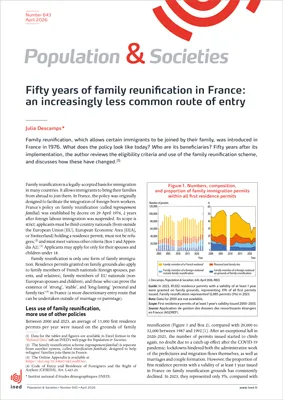
Between 2000 and 2023, an average of 11,000 first residence permits per year were issued on the grounds of family reunification (Figure 1 and Box 2), compared with 20,000 to 32,000 between 1987 and 1992 [1]. After an exceptional lull in 2020–2021, the number of permits issued started to climb again, no doubt due to a catch-up effect after the COVID-19 pandemic: lockdowns hindered both the administrative work of the prefectures and migration flows themselves, as well as marriages and couple formation. However, the proportion of first residence permits with a validity of at least 1 year issued in France on family reunification grounds has consistently declined. In 2023, they represented only 5%, compared with 11% in 2000 (Figure 1), and only 16% of permits granted for family reasons, compared with 23% in 2000 (Appendix A1).
Why have entries via the family reunification scheme declined?
The first possible reason relates to the tightening of the legal requirements for family reunification, which has narrowed the pool of potential beneficiaries (Box 1 and Appendix A2). It may be that families have decided not to file applications using this scheme and turned to other residence schemes, whether family-related or not. Certainly, other legal pathways to residence have been opened up to those with family ties to foreigners in the country. The number of permits issued to the family members of foreign nationals outside of the family reunification policy increased between 2000 and 2023. At the top of the social ladder, the creation of the skills and talents card in 2006, replaced in 2016 by the ‘talent passport’, facilitated access to residence for the family members of highly skilled workers. Among less privileged families, the so-called ‘Sarkozy’ circular of 13 June 2006 and ‘Valls’ circular of 28 November 2012 created a system for the in-country regularization of certain undocumented individuals: the parents of children schooled in France and the spouses of legally resident migrants. Lastly, the expansion of the European Union has automatically increased the number of permits issued to the family members of EU nationals. More broadly, the increase in permits issued to students or on economic and humanitarian grounds (Appendix A3) explains the relative decline in residence permits issued on family grounds, including family reunification.
Changes in family reunification scenarios
The second explanation for the decline in family reunification is linked to changes in the social and family profiles of migrants. Upon arrival in France, three family scenarios are possible. Applicants may already have formed their family prior to migrating, the scenario for which the family reunification scheme was intended. However, the family may also be formed after the applicant has arrived in France [2]: this is the scenario for immigrants who enter France as minors and subsequently form a family abroad. Lastly, individuals who enter France as single, childless adults and then form a family abroad may also apply to bring them in on the grounds of family reunification. Forming a family is understood here in the legal sense, i.e., getting married or formally recognizing children.5
In 2000, each of these three applicant scenarios corresponded to one third of family reunification applications (Figure 2). By 2023, 60% of applicants were immigrants who entered France as unmarried, childless adults. This trend reflects more general changes in the profiles of new migrants, the majority of whom are single and childless on arrival [3], entering France on student visas. They also have more opportunities to find a partner within France, in a growing community of foreign nationals. Furthermore, the rising average age at marriage and the decline of marriage in their country of origin may also explain the increasing proportion of applicants who arrive in France as single people, in the legal sense. Family life now begins more often after an immigrant’s arrival in France, such that certain people get married remotely before being able to initiate the process. These changes mean that the family reunification scheme has become a less appropriate system for contemporary migration and family realities than it was on its introduction.
Gendered migration flows
In 2023, 81% of applicants were men (Figure 2). Conversely, 55% of potential beneficiares were women and 37% were children (Appendix A4). In terms of residence permits issued, excluding documents issued to minors, family reunification is the family-based residence scheme with the highest proportion of women beneficiaries (Appendix A5). With its requirement for two-stage family migration and its stable income criteria, the family reunification scheme is particularly well-suited to the gendered migration scenario for which it was intended in 1976: that of a female spouse, alone or with her children, joining a foreign-born working male spouse already living in France. This scenario still represents 76% of applications. Less frequent situations involve women seeking to bring in a husband (10%), husband and children (1%) or children only (8%) as well as men wishing to bring in children only (6%). Family reunification remains almost exclusively heterosexual. In 2023, 10 years after becoming eligible for the scheme, same-sex married couples represented less than 1% of applications.
In 2023, half of applicants came from the Maghreb region
As of 2023, applicants represented 115 different nationalities. Despite some diversification, which can also be observed for all first residence permits issued in France (Département des statistiques, des études et de la documentation, 2021), the individuals requesting family reunification primarily originated from the Maghreb region (51%) and sub-Saharan Africa (28%) (Figure 3).
This breakdown by origin provides only a partial picture of migrant stocks. For example, the successive expansions of the European Union, in 2004, 2007, and 2013 particularly, have exempted nationals from the countries in question from the system, which explains why almost no applications come from Europe (2% in 2023), despite the fact that Europeans represent more than 1 in 3 immigrants as of 2023 [4]. In 2010, the peak observed for the Americas region corresponds to a sharp increase in Haitian applicants (who represented 11% of applications in that year). The January 2010 earthquake and the subsequent humanitarian crisis seemingly prompted Haitian immigrants in France to apply for family reunification.
Variable processing times...
In 2023, the average period between submission of an application and the administrative decision was 10 months. This processing time is higher than the statutory 6-month period within which prefectures are required to process an application and varies from one region to the next. In Île-de-France, where the number of applications submitted to each prefecture is particularly high, the average processing time recorded exceeds 12 months (Figure 4). Until the mid-2010s, variations in processing time correlated with the number of applications submitted, but this is no longer the case. While the number of applications submitted in Île-de-France has remained stable, or even fallen, the processing time has increased, likely due to insufficient resources for reviewing case files within a reasonable time—a situation that well pre-dates the COVID-19 pandemic.
...requiring financial and residential resources
The application acceptance rate is 82% as of 2023, a higher rate than in the past, when it has fluctuated (Appendix A6). The more stringent criteria for requesting family reunification may have discouraged applications from families with less robust application files.
In total, in 2023, the 18% of applications refused (Figure 5) were mainly rejected due to insufficient income (11%) or because the housing criteria were not met (3%). Applications submitted by women were more likely to be rejected on one of these two grounds (16%) than those submitted by men (13%). Immigrants from sub-Saharan Africa, Europe, and Turkey or the Middle East also had more difficulties meeting these income and housing criteria. Conversely, rejection rates were lower among immigrants of Asian origin. The same is true for immigrants from the Maghreb region, primarily due to the less stringent requirements applicable to Algerians (Box 1). In Île-de-France, inadequate housing is cited as the reason for rejection three times as often as elsewhere, reflecting the housing shortage there and the difficulties faced by immigrants trying to obtain accommodation of sufficient size. The housing crisis may explain the fall in applications submitted in Île-de-France and the increase in those filed elsewhere in France since the mid-2010s. Lastly, high rejection rates among applicants from Europe (outside the EU, EEA, and Switzerland) and the Americas reflect that they are more likely than others to submit applications when their family is already in France, since they can obtain access more easily (due to geographical proximity or ease of obtaining a short-stay visa).
***
The declining use of the family reunification scheme has been driven by multiple factors: the narrowing of the pool of potential beneficiaries; the opening up of other entry routes for families; and changes in the profiles of migrants (younger, more educated), their partnerships (decline in marriage), and the ways they start a family. Family reunification appears, moreover, a restrictive and inflexible pathway to residence in terms of both time frame and the criteria to be met. Nonetheless, it remains a right open to family members of third-country nationals, considering that other entry routes for these families are not any simpler.
Box 1. The rules on family reunification have become increasingly strict
Since 1976, the rules of the general scheme* for family reunification have become more and more strict (Appendix A2). Not only has the required period of legal residence in France prior to family reunification been extended, the rules on applicant income have also been clarified and tightened: since 1993, applicants must earn the minimum wage (SMIC) and family allowances are excluded from income for eligibility calculations. Housing size criteria were also introduced in 1999. Since 2003, the validity of residence permits issued to spouses through the scheme has been limited to 1 year, whereas previously they were aligned with the validity of the applicant’s permit. Since 2006, moreover, spousal permits can be cancelled if the couple separates within 3 years of reunification. Since the mid-2000s, beneficiaries’ mastery of French and their knowledge of the values of the French Republic are assessed as a way of evaluating their level of integration. The scope of potential beneficiaries has contracted: polygamous families are excluded, and ‘in-country reunification’ (applications submitted where potential beneficiaries are already in France), and ‘partial family reunification’ (applications that exclude certain family members) have been withdrawn. An exception to this progressive tightening of the regulations was the 2013 opening of family reunification to same-sex couples, the same year same-sex marriage was legalized in France.
_______
* These legal provisions do not apply to Algerians, who, under the Franco–Algerian Agreement of 1968, benefit from less stringent requirements, particularly in terms of mandatory income and duration of residence [5].
Box 2. The AGDREF database
The AGDREF database (Application de gestion des dossiers des ressortissants étrangers en France—database of foreign nationals residing in France) is operated by France’s Ministry of the Interior and stores information on residence permits requested and issued in France. It excludes individuals who do not require a residence permit, such as EU, EEA, and Swiss nationals, minors,* and people without legal status who have never taken steps to regularize their situation. The statistics produced here on residence permits issued are for third-country nationals of the EU, EEA, and Switzerland (a scope that contracted over the period of study), and based on first residence permits of with a validity of one year or more, issued between 2000 and 2023, excluding documents issued to minors. We excluded the years 2024 and 2025 given the period required by prefectures to process permits.
The AGDREF subset on family reunification records the applications received by the prefecture (forwarded, if complete, by the French Office for Immigration and Integration [OFII]) and contains information on the foreign national who submitted the application (the applicant) and the composition of their eligible family—children under 18 and spouse.
_______
* Minors do not have to have a permit but some do appear in the AGDREF system (beneficiaries of family reunification and those for whom their parents have requested a document de circulation to enable them to travel).
Author
Julia Descamps - Institut national d’études démographiques (Ined).
Related documents
Referens
[1] Tribalat M. 1994. Chronique de l’immigration. Population, 49(1), 161–210. https://www.persee.fr/doc/pop_0032-4663_1994_num_49_1_4574
[2] Thierry X. 2007. Caractéristiques démographiques des ouvrants droit au regroupement familial. In Regnard C. (ed.), Immigration et présence étrangère en France en 2006. Rapport annuel de la DPM (p. 58). La Documentation française. https://hal.science/hal-02081811/
[3] Pailhé A., Hamel C. 2016. Avoir des enfants en contexte migratoire. In Beauchemin C., Hamel C. and Simon P. (eds.), Trajectoires et origines (p. 323–352). Ined Éditions. https://doi.org/10.4000/books.ined.906
[4] Raynaud É., Roussel P. 2024. France, portrait social. Édition 2024. INSEE. Insee Références. https://www.insee.fr/fr/statistiques/8242421
[5] Cohen M. 2020. Des familles invisibles. Les Algériens de France entre intégrations et discriminations (1945-1985). Éditions de la Sorbonne.
Footnotes
- 1
Data for the tables and figures are available in Excel format in the ‘Related Data’ tab on INED’s web page for Population & Societies.
- 2
The family reunification scheme (regroupement familial) is separate from another system, called réunification familiale, designed to help refugees’ families join them in France.
- 3
The Online Appendix is available at https://doi.org/10.34847/nkl.6adft3ec.
- 4
Code of Entry and Residence of Foreigners and the Right of Asylum (CESEDA), Art. L423-23.
- 5
These applicants may therefore have been in a consensual union upon arrival in France.