
Savings for children: significant social and family-related disparities

Abstract
From birth or soon after, one in three children has a savings account set up in their name. By the time children are approaching adulthood, this proportion has increased to more than two in three, but differences in the amounts saved per child are significant. A minority already have substantial savings, some comparable with the savings of low-income adult households. While no difference is noted between girls and boys, children’s savings do vary according to numbers of siblings and family situation. Inequalities between children primarily reflect the wealth of the family in which they grow up.
Article
Savings for children: significant social and family-related disparities
Savings for children: significant social and family-related disparities
From birth or soon after, one in three children has a savings account set up in their name. By the time children are approaching adulthood, this proportion has increased to more than two in three, but differences in the amounts saved per child are significant. A minority already have substantial savings, some comparable with the savings of low-income adult households. While no difference is noted between girls and boys, children’s savings do vary according to numbers of siblings and family situation. Inequalities between children primarily reflect the wealth of the family in which they grow up.
Savings, child, savings account, wealth, inequalities, adolescent, inheritance, family, siblings
Table of contents
- Appendix A References
While some children have a savings account or another savings product opened in their name at birth, others reach adulthood without one. How common is it for families to save money in their children’s names? Which children benefit? What amounts are saved and how do these vary by social background and family configuration? Marion Leturcq sheds new light on saving “for the children”, based on data from the Patrimoine household wealth surveys.1
Saving in a child’s name is common practice among families: it involves opening a savings account or product in the child’s name, at birth or during their childhood, into which parents and family members deposit money. These savings can play a vital role when the child reaches adulthood: helping to fund studies, pay for driving lessons, serve as a deposit for a home, or enable the purchase of a car. However, not all families have the same resources or the same desire to set money aside. While some children have a savings product opened for them at birth, others reach adulthood without one.
Children’s savings remain a blind spot in studies on childhood inequalities. They can be viewed as a form of investment made by parents and relations on behalf of children, and may come alongside other investments in income and time spent with them, all of which widen opportunity gaps between children [1].
This article documents, for the first time, the frequency, size, and distribution of children’s savings in France. It draws on data from INSEE’s five household wealth surveys, Patrimoine, conducted between 2003 and 2021. We grouped the five waves together to establish a large sample of 28,656 children (see Box).
Saving for children: a practice that varies widely
For a child, having a savings product in their name becomes more common with age. Around 35% of children aged 0–1 already have an account, with this figure rising to 53% at age 10–11 and 72% at age 16–17 (Figure 1). In total, nearly 55% of children have a savings product, with no notable difference between girls and boys (Appendix, Figure A12). This percentage remained relatively stable over time during the period examined (Appendix, Figure A2).
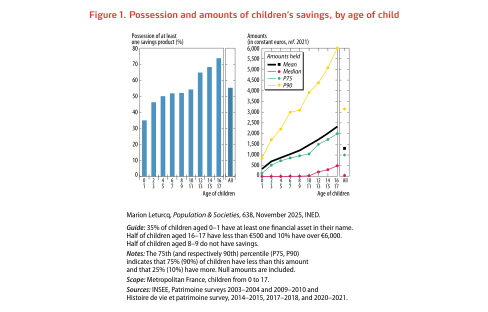
The majority of savings products opened on behalf of children are savings accounts (livrets). Nearly one in two children (47%) have an account such as a livret A or livret jeune, which is a regulated savings account for youth aged 12–26. A minority of children combine one of these accounts with a compte épargne-logement (home savings account) (4%) or a financial product with a better rate of return, such as an assurance-vie (life insurance wrapper) or plan d’épargne retraite (retirement savings plan) (2%) (Appendix, Figure A5).
On average, children’s savings amount to €1,300, but this figure masks significant disparities, with half of children having no savings or only a few euros, while 10% have more than €3,150. Furthermore, the amounts, particularly for the most well-off children, increase with the child’s age: for children aged 0–1, average savings are €350 and 10% of children have over €850. At 10–11, they have €1,470 on average and 10% have more than €4,000. At 16–17, children have €2,330 on average and, for 10% of them, their savings exceed €6,000.3
Lastly, while the percentage of children with a savings product has remained stable over time, the average amount in constant euros has risen, from around €920 in 2004 to €1,680 in 2021 (Appendix, Figures A2 and A4).
Concentration of wealth allows us to measure inequalities in savings between children by revealing the distribution of total children’s savings within the overall child population. For each age, we classified the children by the amount of their savings, from the most to the least wealthy. If children’s savings were distributed evenly, the wealthiest 10% would hold 10% of the total savings, and the less wealthy half would hold half of the total savings. However, we observe instead that the wealthiest 10% of children possess 74% of the total savings set aside for children and the next 10% hold 15%, while more than half of children have no savings in their name (Figure 2).
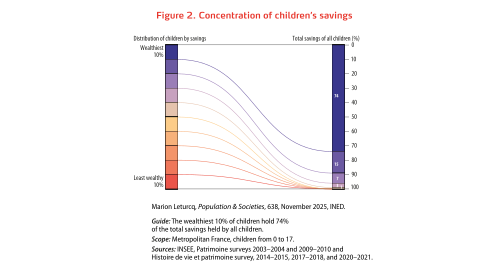
Concentration of wealth is significant at all ages: 10% of children aged 0–1 hold nearly 80% of the total savings set aside at these ages. At age 10, despite the practice being more widespread, the wealthiest 10% still hold 75% of the total, and at age 16 they hold 70% (Appendix, Figure A3).
Children’s savings reflect parental wealth
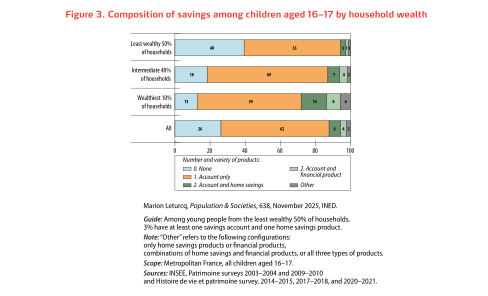
In order to explore the link between parental wealth and children’s savings, we classified the households into three groups, based on total household income: the least wealthy 50%, the intermediate 40%, and the wealthiest 10%. Here we are looking at children aged 16–17.
Unsurprisingly, having savings in various forms is linked with level of parental wealth (Figure 3). Among children in the least wealthy households, 40% have no savings product at all at age 16–17, versus only 13% of those from the wealthiest households. In all groups, the majority of savings are primarily held in the form of savings accounts, but children growing up in the wealthiest households are more likely to have several savings products in their name. The percentage of children with at least two types of savings is 4% in the poorest group versus 22% among the wealthiest households. Children from the latter are therefore more likely to have home savings products or financial products (assurance-vie, plan d’épargne en actions [PEA], plan d’épargne-retraite [PER]), which have a better rate of return than savings accounts.
Among children from the least wealthy 50% of households, half have no or almost no savings and only one child in ten has more than €2,900 (Figure 4). Among those from the wealthiest 10% of households, half have more than €1,855 and one child in ten has more than €19,400.
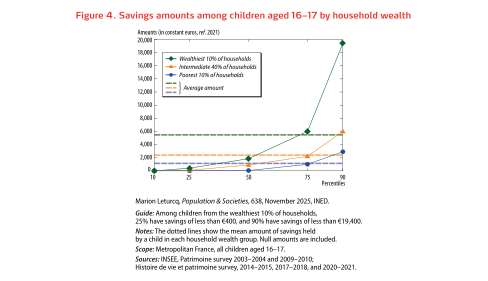
These figures show that the savings deposited on behalf of children largely reflect the wealth of the household to which they belong: the wealthier the household, the more likely the children are to have significant and diversified savings. Nonetheless, these data also reveal wide disparities within each group. At a similar level of household wealth, some children possess wealth close to that of a young adult, while others have no savings products in their name. This suggests that factors other than household wealth also play a part.
Family environment has some effect on children’s savings
What is the impact of the family and social environment for given household wealth levels and sociodemographic characteristics? Children aged 16–17 who live with both parents have average savings of €2,315 (Figure 5). When other characteristics are the same, including household wealth (for method, see Box), children in single-parent families have slightly less savings (€2,099) and children in blended families have much less (€1,633). However, these figures do not include savings deposited for the child by the other, non-resident parent (often the father).

Number of siblings is also a decisive factor: all else being equal, savings per head declines sharply with the number of children in the household: only children have savings of €3,112, in families with two children the latter have €2,640 each, and children in very large families (four children or more) have around €1,338.
For other given household characteristics, we see few differences in savings amounts based on the socioprofessional category of the father (or of the mother, if the father does not live with the child) except among farmers, who set much more aside for their children than other categories, even at identical wealth levels. A gap emerges between, on the one hand, children from households where at least one adult has a tertiary qualification and, on the other, children from households where none of the adults has a degree. Among the former, savings are in the region of €2,500, while for the latter, they are only around €1,500 (Appendix, Figure A6).
The importance of grandparents to the savings set aside for children
Children’s savings also reflect support received from the extended family, in particular from grandparents (Figure 6). When all grandparents are still living,4 the amounts saved for children aged 16–17 tend to be more, suggesting intergenerational support. A child living with both parents, therefore, and with four living grandparents has savings of €3,300, while a child with none or only one living grandparent has savings of €1,900. Likewise, children living with one parent only, where the two grandparents are still alive, have more savings than those with none or only one living grandparent.
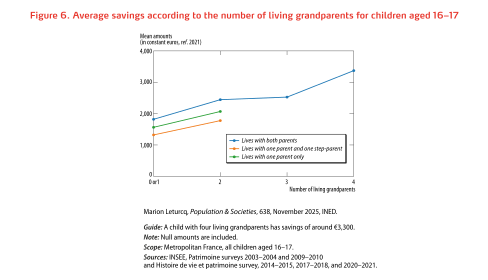
If at least one parent has received an inheritance or gift inter vivos (donation du vivant), the savings set aside for children are larger, irrespective of family configuration (Appendix, Figure A7). These results suggest that grandparents are a factor in the financial disparities between children, either through their direct contributions to children’s savings or through the transfer of wealth to parents.
***
Inequalities in terms of individual savings, therefore, emerge from early childhood and become wider at adolescence. On reaching adulthood, many children have nothing or almost nothing, while a minority already have substantial financial savings, sometimes comparable with those of low-income adult households. These disparities primarily reflect the wealth of the household in which they grow up.
Various foreign schemes have introduced specific savings products known as child development accounts. Their aim is to encourage saving for children, particularly among low-income households [1], and to reduce inequalities of opportunity by guaranteeing a minimum level of resources to everyone at the key moment of reaching adulthood. While this idea has also been discussed in France [3][4], no such scheme has been implemented. Saving money for children remains a widespread practice among families but a highly unequal one, based on social factors.
Box. Data and methods
The analysis is based on the Patrimoine (2003–2004 and 2009–2010) and Histoire de vie et patrimoine (2014–2015, 2017–2018, and 2020–2021) surveys on household wealth and life, conducted by INSEE, the French Institute of Statistics and Economic Studies. For each survey, the 10,000–15,000 households questioned were representative of the French population. These surveys collected detailed information about household assets and liabilities, including any financial products opened in children’s names, as well as about the sociodemographic characteristics of household members.
To measure the savings deposited for children, we used the financial wealth management vehicles reported: savings accounts (livret A, livret jeune, etc.), home savings schemes (épargne-logement plan or account), and financial products (life insurance [assurance-vie], retirement savings plans [épargne-retraite], shares, etc.). We excluded current accounts, which are very widely reported from the age of 16 but are mainly used for managing day-to-day finances. The amounts are expressed in constant euros (ref. January 2021). The surveys do not provide a way of identifying any property- or work-related wealth that some children might also have.
The five surveys were regrouped into one cumulative sample of 28,656 children, observed at least once and for whom at least one parent responded to the survey (children were therefore excluded from the analysis if the respondent was a step-parent). The data were studied as repeated cross-sectional snapshots: variation by age was determined by observing different children at various ages rather than the same children followed up over time. The survey weights, normalized to 1 for each survey, were applied to all analyses.
Children were only observed in one household. For those living with only one of their parents, only the resident parent was observed. Savings deposited by the non-resident parent were not necessarily observed in the surveys.
To measure the effect of family environment, we used a two-part model that distinguishes the probability of having any savings at all (calculated using logistic regression) from the amount of those savings (calculated using linear regression), where relevant. The control variables were: household wealth; family type; number of children belonging to the adults in the household (whether living there or not); the death of one parent; being an apprentice (as the child then receives remuneration); the age of the oldest adult in the household; the highest educational qualification held by any resident adult; the socioprofessional category of the father (or of the mother if the father does not live with the child); household income, and, lastly, survey wave. The predicted amounts for the variable under consideration were then calculated with the other control variables held at their mean. Standard deviations were calculated by bootstrap (100 replicates).
______
Translation done by Beatrice van Hoorn Alkema
Appendix A References
- [1] OECD. 2025. To have and have not. How to bridge the gap in opportunities. OECD Publishing. https://doi.org/10.1787/dec143ad-en
- [2] Cheptitski A., Goin A., Jaubertie A., Martin H. (dir.). 2024. Revenus et patrimoine des ménages. Édition 2024. INSEE references. https://www.insee.fr/fr/statistiques/7941421?sommaire=7941491
- [3] Centre d’analyse stratégique. 2007. Les dotations en capital pour les jeunes. Rapports et documents, 9. French documentation. https://www.vie-publique.fr/files/rapport/pdf/074000614.pdf
- [4] Damon J. 2021. Investir dans la jeunesse. Futuribles, 441(2), 65-70. https://doi.org/10.3917/futur.441.0065
Data for the tables and figures are available in Excel format in the “Related documents” tab on the Population & Societies webpage.
Online appendix available at: https://nakala.fr/10.34847/nkl.fd8c5eyy
By way of comparison, according to INSEE, half of households with a reference person aged between 18 and 30 have net wealth of under €15,800 as of 2021, 10% less than €1,500, and 10% more than €112,400 [2].
For the purposes of our data, we observed only the parents of the parent or parents living with the child. As such, we only know the total number of living grandparents if the child lives with both their parents; otherwise, the information is incomplete.
Author(s)
Marion Leturcq - Institut national d’études démographiques (INED), F-93300 Aubervilliers, France