
Seven in ten women over the age of 60 face an average of 13 years of widowhood
Abstract
Loss of a partner generally results in a long period of widowhood, lasting 13 years on average. This duration, estimated based on life tables, should shorten slightly by 2070. It is longer for widows from poorer households than for those from wealthy households, and therefore represents an even greater proportion of their old age. In Europe, widowhood seems to last longer in countries where the longevity gap between women and men is wide. European comparisons place France in a median position.
Article
Seven in ten women over the age of 60 face an average of 13 years of widowhood
Seven in ten women over the age of 60 face an average of 13 years of widowhood
Loss of a partner generally results in a long period of widowhood, lasting 13 years on average. This duration, estimated based on life tables, should shorten slightly by 2070. It is longer for widows from poorer households than for those from wealthy households, and therefore represents an even greater proportion of their old age. In Europe, widowhood seems to last longer in countries where the longevity gap between women and men is wide. European comparisons place France in a median position.
widowhood, death of a partner, duration, survivor pension, couple, marriage, France, Europe
Table of contents
- Appendix A References
The likelihood of losing one’s partner increases with age. Nearly one in three women over the age of 60 is a widow, with this proportion increasing to one in two past 75. What is the duration of widowhood for women in France and across Europe? Does it vary by standard of living? How is it likely to change in the future? After defining and quantifying widowhood, the authors estimate its duration for women in France and Europe.1
In France, as of 2020, nearly one in three women aged 60 or over had the legal status of widow. Widowhood can represent a period of loneliness and vulnerability, particularly if the death of a partner results in reduced resources. This resource loss may include human as well as financial resources, such as moral support or help with daily living previously provided by the partner. Consequently, widowhood and the financial protection provided by the government is a recurrent topic of public debate, particularly in relation to pension reforms and survivor pensions. When one member of a couple dies, a survivor pension allows the surviving individual, under certain conditions, to receive some of the deceased’s pension. As of 2024, survivor pensions represented 38.7 billion euros, or 1.3% of France’s GDP, and are only paid to surviving partners if the couple was married.
What is widowhood?
In legal terms, in France, widowhood refers to the situation of a previously-married individual whose spouse is deceased. It is a marital status recognized by the civil registry system.2 In practice, the loss of a partner is also experienced by unmarried couples, those in a cohabiting union, or partners bound by a civil solidarity pact (pacte civil de solidarité, PACS). This is referred to as de facto widowhood: the individual does not have the legal status of a widow or widower, but experiences a similar situation.
Widowhood is of relevance to social protection institutions, particularly as regards the payment of survivor pensions, and in this context we might define widowhood on the basis of survivor pension reception. However, this operational definition does not accurately reflect reality since not everyone who has lost a partner receives such a pension; including individuals who were never married, for example. Furthermore, some eligible individuals do not claim a survivor pension, while others, such as divorcees, may have access to one even though the deceased was their ex-partner, rather than their partner, where the rules of the deceased’s pension scheme allow.
At age 75 and over, one woman in two is a widow
In France, more than nine out of ten couples over 60 are married; therefore, widowhood—in the broadest sense of losing a partner through death—primarily affects married individuals. Deaths within unmarried couples, PACSed couples, or those in a cohabiting union are rarer, but numbers could increase as generations in which marriage is less common reach older ages. It is also more difficult to identify these situations from administrative data if the surviving partners do not have the legal status of a widow or widower or do not have access to a survivor pension.
Widowhood primarily affects older people, and older women in particular. In 2022, around 250,000 married individuals—170,000 women and 77,400 men—became widowed.3 In total, as of 2020, there were around 3.6 million legally-recognized widows and widowers among people aged 60 or over, 81% of whom were women. That same year, 3.8 million people of all ages received a survivor pension [1]—a higher figure, which includes divorcees who had lost their ex-partner. Some 87% of these survivor pension beneficiaries were women.
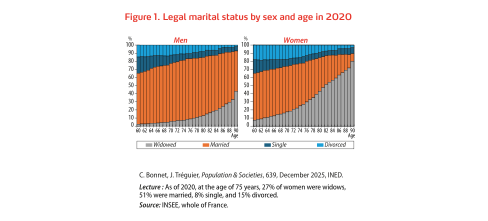
The proportion of widows increases sharply with age: one in three women over 60 has the legal status of widow, and among women over 75 this increases to one in two (Figure 1). This distribution is primarily explained by shorter life expectancy among men and age differences between partners, with men, on average, being older. As such, at the time of their death, six in ten women over 60 have the legal status of widow, while only two in ten men are widowers, the majority being married at this point. This difference also results from a greater tendency among men to remarry after widowhood.
What is the duration of widowhood among women?
Widowhood is often perceived as an event—the loss of a partner—but it is also a period of life that can significantly vary in length.
How long do people remain widows or widowers, on average? We still know relatively little about how much time is actually spent in this situation. Data drawn from French pension schemes provide information on survivor pension payments, but these only reflect a subpopulation of widows: those who were formerly married, are eligible for a pension, and have claimed it. France’s national pension fund (Caisse nationale d’assurance vieillesse, CNAV) indicates that in 2023, the average duration of survivor pension payments to women was 16.9 years.4 Aside from this administrative information, there are some research studies in which this duration has been estimated. For example, a study from 2011 [2] indicated that women from the 1920 to 1950 generations, aged 60, married, and who survived their husband, would remain widowed for around 15 years.
In order to update and expand this overview, taking all widowhood situations into account (whether the couple was married or not, whether there is a survivor pension or not), another method is to simulate, at each age, the risk of losing one’s partner, based on the life tables for men and women (Box 1). The aim is to highlight the general trends in the duration of widowhood, its social inequalities, and international variations, using two indicators: probability of widowhood and conditional duration of widowhood, i.e. its average duration for people who have experienced the loss of their partner.
These simulations are based on hypotheses that are necessarily somewhat simplified, as set out in Box 1. Since women form the majority of widowed individuals and these hypotheses deviate less from reality in their case than for men, our analysis is focused on women. However, the indicators can also be calculated for men [5].
On average, a 60-year-old woman will experience 13 years of widowhood
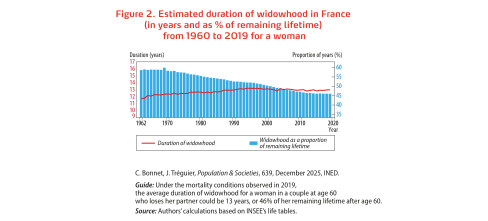
Around 70% of women in a couple at age 60 will experience widowhood. Under the mortality conditions for women observed in 2019 (Box 2), their expected duration of widowhood after age 60 is estimated at 13 years (Figure 2). With a 28-year life expectancy at age 60, this corresponds to almost half (46%) of their remaining lifetime.
How is duration of widowhood changing over time? Average duration of widowhood increased slightly between 1962 and 1995, and has stabilized since (Figure 2). So, as of 2019, a widowed 60-year-old could expect to experience one more year of widowhood than in 1962. However, thanks to gains in life expectancy, the proportion of their remaining lifetime that 60-year-old women are likely to spend in widowhood fell from 59% in 1962 to 46% in 2019.
The poorest women remain widowed longest
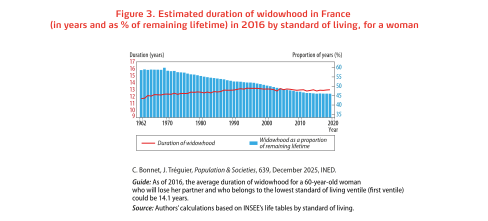
Duration of widowhood varies significantly according to monetary standard of living [6]. The life tables produced by INSEE can be used to estimate duration of widowhood based on couples’ standard of living prior to widowhood, from the poorest 5% (the first ventile) to the wealthiest 5%. Women from the poorest couples experience 14.1 years of widowhood on average, almost 3 years more than women from the wealthiest couples (11.4 years) (Figure 3). Since their resources and their survivor pensions—linked to the size of their deceased husband’s pension—are smaller, this extended duration may increase their risk of poverty. For widows from the poorest households, this period forms a significant portion of their remaining lifetime after age 60, due to earlier widowhood and a shorter life expectancy: for these women, widowhood represents 57% of remaining lifetime after age 60, compared with only 38% among the wealthiest women.
Duration of widowhood should decrease in future
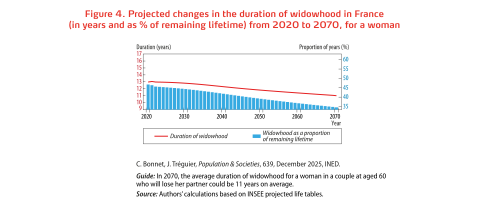
Future trends in the duration of widowhood will be closely linked to changes in male and female mortality. According to INSEE’s population projections, the gaps between male and female life expectancy should halve by 2070, while variation in age at death should also be reduced. These changes would, by 2070, extend the period of life spent living as a couple and, therefore, lead to a decrease in the average duration of widowhood among women, which would then fall to 11 years (Figure 4). The likelihood of widowhood would also be impacted: while in 2019, the woman died first in one-third of couples, this proportion would slightly increase by 2070 to 36%.
Estimated duration of widowhood among women in France: median position within Europe
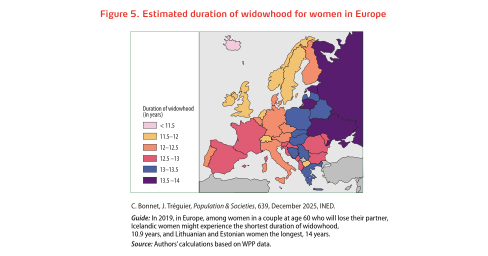
Does the duration of widowhood observed in France differ from that of its European neighbours? Probability of widowhood varies significantly between European countries. As of 2019, in the Baltic states, likelihood of widowhood differs greatly by sex: probability of widowhood is 74% for women and only 26% for men in a couple. In contrast, in Iceland, the United Kingdom, and the countries of Northern Europe, differences in probability by sex are less marked: the likelihood of widowhood among women is lower in these countries (between 61% and 65%) and 35% to 40% of men outlive their partner.
The expected duration of widowhood for a 60-year-old woman also varies widely: from 10.9 years in Iceland to 14 years in Lithuania and Estonia (Figure 5). Three groups of countries stand out: Nordic countries (Iceland, Netherlands, Norway, Sweden) have the shortest durations (less than or equal to 11.5 years); Russia and the Baltic states have the longest durations (around 14 years); and the former Eastern bloc countries sit just below (around 13 years). France occupies a central position, at 12.7 years, close to that of Spain but higher than those of its immediate neighbours (Italy, Belgium, Germany, Austria: 12.1–12.3 years).
These differences are much more closely linked to mortality differences between the sexes—which are more significant in the former Eastern bloc countries, for example, and are associated with country-specific gender differences in behaviours and lifestyle (smoking, alcohol consumption, working conditions, etc.)—than they are to age gaps between spouses, which vary little and have a limited impact on the likelihood and duration of widowhood [5].
***
Widowhood is a common experience, particularly among elderly women, and lasts longer among the least wealthy groups. In Europe, widowhood is experienced for longest in countries with a large gap in longevity between women and men. These findings call into question the ability of the social protection system to support this stage of life, particularly in view of evolving forms of couples: currently, widows and widowers from unmarried or PACSed couples or cohabiting unions are unable to access survivor pensions.
Box 1. Estimating duration of widowhood
The estimated duration of widowhood corresponds to the number of years an individual can expect to live after the death of their partner in a given mortality context by sex and age. To calculate it, we use life tables, which show probability of death at each age, following a method initiated in the United States [3].
The approach models this duration for a 60-year-old woman in a couple with a 62-year-old man (2 years being the mean age difference between spouses in France), and proceeds as follows. At each age a, the probability of a woman becoming a widow is the product of the probability of her partner dying at age a + 2 (expressed as dma+2) and the probability that she is still alive at this age a (expressed as sfa). If she becomes widowed at age a, she can then expect to live another efa years (life expectancy at that age). By adding up these weighted life expectancies at each age, from 60 to 120 years, we obtain an average duration of widowhood for the population of 60-year-old women. We then need to make this duration conditional upon becoming widowed. We therefore divide it by the probability (risk) of widowhood that we have also calculated.

This estimate is based on four simplifying hypotheses.
Firstly, we have assumed that the probabilities of dying are the same for people in a couple as for others. However, we know that people living as a couple generally benefit from better survival than those living alone.
Secondly, the mortality correlation between partners has not been taken into account. Partners’ chances of survival are connected, primarily due to their shared lifestyle habits, the risk of simultaneous death during a single event (car accident, for example), and the excess mortality observed after widowhood [4].
Thirdly, the age gap between partners has been set at 2 years, despite the fact that, although it remained fairly steady over the years covered by the study, there is some variability within the population.
Lastly, we have assumed that the union is only terminated due to widowhood, without prior separation, and that there is no subsequent re-partnering; a reasonable hypothesis for individuals over the age of 60, since this remains a relative rare event, particularly among women.
The effects of these assumptions are quantified and discussed in detail in another study [5].
Box 2. Data used
Duration of widowhood is calculated from two types of data source:
i) Life tables
For France, we used INSEE’s life tables (2021 version), which give mortality quotients by age for women and men between 1962 and 2019; the life tables extracted from the central scenario of its 2020–2070 population projections; and those by household living standard for 2016 [6].
For the European comparison, we used life tables by age and sex from the 2024 World Population Prospects (WPP) produced by the United Nations, whose mortality quotients are harmonized so that data from different countries can be compared.(a) See https://population.un.org/wpp/downloads?folder=Standard%20Projections&g…
ii) Mean age gaps between spouses in Europe
These are taken from the World Bank’s 2019 World Marriage Data, which provides information on the mean age of women and men at first marriage. See https://genderdata.worldbank.org/en/indicator/sp-dyn-smam?view=bar#idRe….
---------------
(a) This process involved the use of smoothing, back-projection, and projection methods, based on common demographic models, which can introduce slight discrepancies compared with national data (such as INSEE’s data for France).
______
Translation done by Beatrice van Hoorn Alkema
Appendix A References
- [1] Marino A. (dir.). 2022. Les retraités et les retraites. Édition 2022. Panoramas de la Drees. https://drees.solidarites-sante.gouv.fr/sites/default/files/2022-07/Retraites2022.pdf
- [2] Pennec S., Gaymu J. 2011. La durée de l’isolement conjugal et de la vie en couple chez les personnes âgées en France : quelles évolutions entre hommes et femmes au fil des générations ? Cahiers québécois de démographie, 40(2), 175–208. https://doi.org/10.7202/1011539ar
- [3] Goldman N., Lord G. 1983. Sex differences in life cycle measures of widowhood. Demography, 20(2), 177–195. https://doi.org/10.2307/2061234
- [4] Shor E., Roelfs D. J., Curreli M., Clemow L., Burg M. M., Schwartz J. E. 2012. Widowhood and mortality: A meta-analysis and meta-regression. Demography, 49(2), 575–606. https://doi.org/10.1007/s13524-012-0096-x
- [5] Tréguier J., Bonnet C., Blanchet D. 2025. How long will you be a widow? Determinants, trends and income gradient in widowhood duration. Demography, 62(2), 467–488. https://doi.org/10.1215/00703370-11846477
- [6] Blanpain N. 2018. L’espérance de vie par niveau de vie. Méthode et principaux résultats (Working document no. F1801). INSEE, Working documents. https://www.insee.fr/fr/statistiques/3322051#
Data for the tables and figures are available in Excel format in the ‘Related documents’ tab on INED’s web page for Population & Societies.
The legal status of widow or widower disappears if the individual remarries.
Author(s)
Carole Bonnet - Institut national d’études démographiques (INED), Aubervilliers
Julie Tréguier - Deutsches Institut für Wirtschaftsforschung (DIW), Berlin