
People in France want fewer children

Abstract
The ERFI 2 survey (part of the international Generations and Gender Programme) shows that the fertility intentions of young people under 40 declined between 2005 and 2024 in France, suggesting that the fertility downturn will probably continue. This decline concerns all social groups but is especially strong among young people. It is linked partly to individuals’ conceptions of the family and of their future. For example, fertility intentions are lower among people who favour gender equality and those who worry about climate change and prospects for future generations.
Article
Institut national d’études démographiques (INED), F-93300 Aubervilliers, France
Institut national d’études démographiques (INED), F-93300 Aubervilliers, France
The ERFI 2 survey (part of the international Generations and Gender Programme) shows that the fertility intentions of young people under 40 declined between 2005 and 2024 in France, suggesting that the fertility downturn will probably continue. This decline concerns all social groups but is especially strong among young people. It is linked partly to individuals’ conceptions of the family and of their future. For example, fertility intentions are lower among people who favour gender equality and those who worry about climate change and prospects for future generations.
fertility, children, intentions, gender norms, worries, climate change, Generations and Gender Surveys, ERFI Surveys, France
Table of contents
- Appendix A References
1.
Fertility in France has declined over the last few years. Is this trend set to continue? Do young people today want fewer children? Are conceptions of gender roles and concerns about climate change affecting their choices? Drawing on data from two major national surveys conducted in 2005 and 2024, the authors examine how and why the intended number of children has evolved.1
As in all the European countries where the total fertility rate was close to 2.0 children per woman in the 2000s, fertility is on a downward path in France, falling from 2.0 children per woman in 2014 to 1.6 in 2024 [1]. Will this sharp decline (20% in 10 years) continue? How many children will today’s young adults have in their lifetime?
1.1. Women born in 1980 have 2.1 children on average
Women born after 1960 reached adulthood after the pill became widely available and abortion was legalized in the 1970s. They had between 2.0 and 2.1 children in all. This number, called cohort completed fertility (Figure 1), is the average number of children that each woman has over her entire reproductive life. It increased slightly for the cohorts born between 1970 and 1980; women born in 1980 had 2.1 children on average. To estimate the completed fertility of women born after 1985 (and who have not yet turned 40), we need to imagine how many children they will have during the final years of their reproductive life.
1.2. Ideal family size and intended number of children are decreasing
The Generations and Gender Survey (ERFI 2, GGS-II) conducted by INED in 20242 provides information on family representations via questions on ‘the ideal number of children in a family’ and, more concretely, on the number of children that respondents intend to have over their lifetime—their ‘intended number of children’—including those already born (see Box 1 for the precise question wording). Comparison with almost identical questions asked in 1998 and 2005 sheds light on changes over the last 25 years.
In 2024, as in 1998 [2], the ideal number of children in a family varied little by age, but it has fallen substantially over the last 25 years, from 2.7 children to 2.3 on average (Figure 1, responses ordered by women’s year of birth).
In 2024, women’s intended number of children was much smaller than the ideal number in a family: women aged 18–24 wanted 1.9 children on average, and those aged 25–34 wanted 2.0 (Figure 1). Intentions do not always translate into reality, however. In 2005, for example, the number of children desired by women born in the 1970s, aged 25–34 at the time, was 0.5 children higher, on average, than the number they actually had in their reproductive lifetime. The decrease between 2005 and 2024 in the intended number of children—0.6 fewer children for women under age 30—suggests that completed fertility will decline among the cohorts born after 1985, even if the gap between intentions and realization narrows.
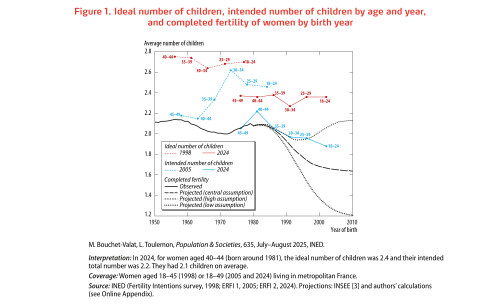
To gauge the uncertainties about the future completed fertility of women aged under 45 today, we ran a series of fertility projections by age, using wide-ranging assumptions, with total fertility levels reaching between 1.2 and 2.0 children per woman in 2035 and remaining steady thereafter, and with a continued increase or stabilization of the mean age at childbearing (Online Appendix). Under all scenarios, women born after 1985 have fewer children than the preceding cohorts: completed fertility ranges between 1.8 and 2.0 children for the 1990 cohort and between 1.6 and 1.9 for the 1995 cohort (aged 30 in 2025). These projections are consistent with the decrease in fertility intentions and in the ideal number of children. For younger women, the future is more uncertain. Those born in the 2000s may have between 1.4 and 2.0 children, but probably around 1.6 on average.
The decrease in average family size—whether ideal, intended, or realized—reflects the declining appeal of large families, whose numbers have been falling for many years, and the recent increase in one-child families and in childlessness. The two-child family model is spreading: at all ages between 18 and 49, two-thirds (65%) of women and men think that two children is the ideal family size, compared with fewer than half (47%) in 1998. ‘Three or more’ is the ideal for a minority (29% in 2024 vs. 50% in 1998), while the share of respondents answering ‘zero or one’ increased but remains very small: in 2024, just 6% reported an ideal number of children below two (Figure 2). The trend in fertility intentions is similar to that of the ideal number of children, with a slight increase in intentions to have ‘two children’ (from 44% to 46% between 2005 and 2024), and a sharp rise in intentions to remain childless (from 6% to 12%) or have only one child (from 12% to 18%). Intentions to have three or more children fell from 38% to 23% (Figure 2).

1.3. Young people want smaller families or are more uncertain
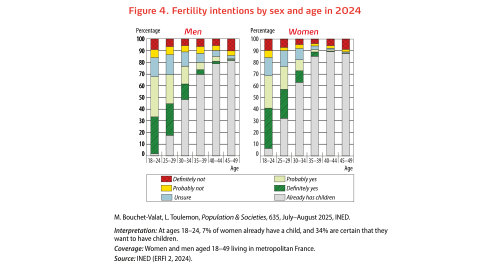
The fertility intentions of young adults under age 30 have decreased much more substantially, with a drop of 0.6 in the average intended number of children in the last 20 years, from 2.5 to 1.9 for women and from 2.3 to 1.8 for men. As is the case for adults as a whole, half of young adults aged 18–29 plan to have exactly two children, but ‘zero or one’ answers now outnumber ‘three or more’, a reversal of the situation observed in 2005 (Figure 3), both for women (27% vs. 22%) and, even more so, for men (35% vs. 15%). The two-child norm, while still strong, now tends to be seen by young people as a maximum rather than a minimum.

Moreover, many young adults are not sure whether they want children at all: among childless people, 17% of under-25s and 20% of 25- to 29-year-olds were uncertain about how to answer the question (Figure 4). The birth of a child is just one possible aspect of a life whose future paths (intimate relationships, place of residence, employment, other activities) remain uncharted before age 35.
1.4. An egalitarian conception of gender roles is associated with lower fertility intentions
Among people aged 25–39, the ages when most births take place, fertility intentions have decreased in all social groups, whatever the sex, age, country of birth, educational level, occupational category, or living standard (Online Appendix). The determinants were largely the same in 2005 and 2024. For similar sociodemographic characteristics, the most educated people intended to have slightly more children (0.3 more than the lowest educated in 2024), as did those born in North Africa (0.3 more than persons born in France) and in sub-Saharan Africa (0.7 more). Sex, occupational category, and living standard made no difference.
The effect of attitudes and opinions has grown stronger, however. While an egalitarian conception of gender roles in society had no impact in 2005, the fertility intentions of respondents holding this opinion were lower in 2024, whatever their sex (Online Appendix, Tables A2 and A3). In 2024, for equivalent sociodemographic characteristics, among those who believed that politics, education, or jobs were more important for men, or that women were more suited to running the home and raising children, 47% probably or certainly intended to have a child (or another child) versus 38% of those who believed that these domains were equally important for both sexes. However, among those holding this opinion, it was only men who wanted a larger number of children (0.3 more), perhaps because women have tended to be more aware of the potential childcare workload [4].
1.5. Major concerns about the future
Growing uncertainty about the future is often given as a reason for the recent fertility decline in Europe. Beyond the economic situation, new sources of concern have emerged in the last decade, whose effects on fertility intentions are still being debated [5]. We examined four of these possible concerns in relation to fertility intentions in 2024—climate change, the economic crisis, the weakening of democracy, and, more generally, prospects for future generations—although the survey respondents may not have been consciously aware of any connection. Whatever the aspect considered, almost half of the respondents aged 25–39 reported being ‘very’ worried. Only a small minority (less than 15%) said they were ‘not very’ or ‘not at all’ worried.
1.6. Worried people want fewer children
For identical characteristics (Figure 5 and Box 1), 35% of respondents aged 25–39 who said they were very worried about prospects for future generations ‘probably’ or ‘certainly’ intended to have a child (or another child), compared with 46% of those who were less worried, and they wanted 0.11 fewer children. Intentions were also lower, although less markedly so, among those concerned about climate change and a weakening of democracy (36% vs. 43% in both cases). While being very worried about climate change is associated with a slightly lower intended number of children (0.08 fewer), the degree of concern about the economic crisis had no impact.
People under age 25 were not more worried than their elders, and the effect of worries on fertility intentions was similar at all ages, for respondents with or without children (Online Appendix, Figure A5).

***
The fertility decline observed in recent years looks set to continue, although the total fertility rate in France will probably remain above the current European average of 1.4 children per woman. Fertility intentions and the intended number of children are decreasing across all social groups in relation to recent changes in individuals’ conceptions of the family and the future, linked to the impact of climate change in particular. But this is doubtless only part of the explanation [6]. The decrease in fertility intentions is linked to broader trends affecting society as a whole.
1.6.1. Box 1. The ERFI 2 survey (Generations and Gender Survey II)
ERFI 2 (Étude des relations familiales et intergénérationnelles; https://erfi2.site.ined.fr) is an online and telephone survey conducted by INED in 2024 on a representative sample of 12,800 men and women aged 18–79 living in ordinary households in metropolitan France (mainland France, Corsica, and other nearby islands). The one-hour questionnaire asked respondents about their partnership and family histories, relationships with their parents and children, gender roles, fertility intentions, etc. ERFI 2 is the French component of the international Generations and Gender Programme (https://www.ggp-i.org), which is conducting this survey in around 20 countries.
In 1998, the question on the ideal number of children asked, ‘What do you think is the ideal number of children in a family?’ (Fertility Intentions survey, INED); in 2024, it was worded as follows: ‘Generally speaking, what do you think is the ideal number of children for a family?’ In 2024, as in 2005 for the first ERFI survey (GGS-I), fertility intentions were recorded via a series of questions on the number of children already born or adopted: first, the intention to have a child, and last, ‘How many more children—including biological and adoptive children—do you intend to have overall?’ Stepchildren (children of a current or former partner) were not counted.
The effect of gender norms and worries on fertility intentions was estimated using regressions that control for the survey administration method (online or phone), sex, age, partnership status, existing number of children, country of birth, educational level, employment status, occupational category, and living standard. Question wording, variable construction, detailed model results, and results by sex for young adults and childless people are given in the Online Appendix. The discussed effects are statistically significant at the 5% level.
Appendix A References
- [1] Thélot H. 2025. Bilan démographique 2024 : En 2024, la fécondité continue de diminuer, l’espérance de vie se stabilise. Insee Première, 2033. https://www.insee.fr/fr/statistiques/8327319
- [2] Toulemon L., Leridon H. 1999. La famille idéale : combien d’enfants, à quel âge ? Insee Première, 652. https://www.bnsp.insee.fr/ark:/12148/bc6p0702dg1/f1.pdf
- [3] Algava E., Blanpain N. 2021. 68,1 millions d’habitants en 2070 : Une population un peu plus nombreuse qu’en 2021, mais plus âgée. Insee Première, 1881. https://www.insee.fr/fr/statistiques/5893969
- [4] Cartier M., Collet A., Czerny E., Gilbert P., Lechien M.-H., Monchatre S., Noûs C. 2021. Allez, les pères ! Les conditions de l’engagement des hommes dans le travail domestique et parental. Travail, genre et sociétés, 46(2), 33–53. https://doi.org/10.3917/tgs.046.0033
- [5] Jylhä K. M., Kolk M., Fairbrother M. 2024. Attitudes towards childbearing, population, and the environment: Examining prevalence and demographic and psychological correlates. (Stockholm Research Reports in Demography No. 41). https://doi.org/10.17045/sthlmuni.26926999.v1
- [6] Veaux C., Roux S. 2023. L’écologie en plus. Des justifications environnementales de la non-procréation. VertigO, 23(2). https://doi.org/10.4000/vertigo.41014
Data for the tables and figures are available in Excel format in the ‘Related documents’ tab on INED’s web page for Population & Societies.
This article refers to an online appendix available at: https://doi.org/10.34847/nkl.bed29126
ERFI 2 is part of the LifeObs research infrastructure (France 2030, ANR-21-ESRE-0037) led by INED, and received funding from the Ministry of Higher Education and Research and the Caisse nationale d’allocations familiales. Alongside the two authors, the survey team members are Ruxandra Breda-Popa, Paul Cochet, and Efi Markou (INED Surveys Department).
Author(s)
Milan Bouchet-Valat - Institut national d’études démographiques (INED), F-93300 Aubervilliers, France
Laurent Toulemon - Institut national d’études démographiques (INED), F-93300 Aubervilliers, France