

Age upon first sexual relations
At 17 and a half (17.7 years of age), half of young people in France have already had sexual relations. Boys continue to have their first sexual experience earlier in life than girls, but only by a few months. And the two sexes still experience the event quite differently.
According to INED’s Envie survey (2023) on the affective life of young adults, the median age upon first non-forced sexual relations—i.e., the age at which half of young people aged 18 to 29 have already had sex—is 17.6 for boys and 17.8 for girls in the 18-29 age bracket.
Girls’ and boys’ ages have pulled closer
Half of women who turned 18 in the early 1950s had their first sexual experience a little after turning 20, versus a little over 18 for men—a two-year difference. In the 1960s and 1970s, the median age upon first sexual relations fell, particularly among women, with the gender gap narrowing to a few months. It then remained stable during the 1980s and 1990s. In the 2000s the median age began to fall again, before rising in the mid 2010s. Overall the experience occurs somewhat later in the lives of the most recent cohorts than in those preceding them.
Young people’s sexuality during lockdown
Looking more closely at the behaviors of men and women aged 18 to 29 in 2023, we observe a notable change: the median age upon first non-forced sexual relations rose perceptibly between the 1996 and 2000 cohorts (Figure). This may have been one manifestation of the #MeToo moment, during which sexual violence came in for a new wave of condemnation (last quarter of 2017). But #MeToo actually came after a new rise in the number of complaints filed for acts of rape or sexual aggression [Bozon 2024], and the rise in age upon first sexual relations may be linked to this groundswell shift. Then during the COVID-19 lockdown periods, age upon first sexual relations rose circumstantially among both men and women, a possible explanation being restrictions on young people’s movements during that time. After the COVID-19 pandemic, that age fell back down to the level observed three years earlier (2021).
Median age upon first sexual relations by year of birth and gender
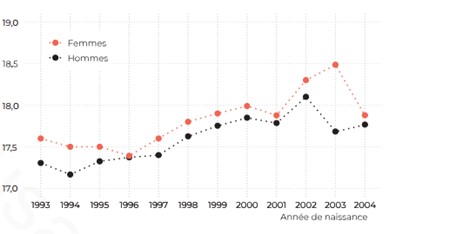
Source: Envie survey, INED 2023
Population: Women and men aged 18-29
Reading: Half of men born in 1993 had their first sexual relations before 17.3 years of age (the median age
Increasingly marked dissociation between first sexual partner and first spouse or cohabitation partner
The beginning of sexual life used to be linked to marriage, particularly for women: their first sexual relations were usually with their husband or the man they were going to marry. Changes in the 1970s—the decline of marriage and corresponding rise in cohabiting unions and longer education, the wide diffusion of modern contraception—went together with a gradual dissociation between first sexual relations and first experience living in a couple. Currently, one’s first sexual partner does not become one’s first spouse or longer-term partner, or only rarely so. In 2023, only 19% of men aged 18 to 29 and cohabiting for the first time were doing so with their first sexual partner, as against 25% of women (Rault and Régnier-Loilier 2025).
Men and women: different ideas of what one’s first sexual experience involves
Men and women continue to attribute different meanings to their first sexual experience, meanings shaped by heavily structuring gender norms. Men see it as a personal learning experience and do not strongly associate it with the start of a longer-term relationship. They seldom report being in love with their first sexual partner. Women, on the other hand, more often say they were in love with their first sexual partner; they do not value, and may well disapprove, having sexual relations for one’s own purposes and without some sense of connection.
Références :
Fantoni-Decayeux, T., Régnier-Loilier, A., 2025. Les « premières fois ». Calendriers diversifiés du premier baiser et du premier rapport, p. 21-34, ans Bergström M. (dir.), La sexualité qui vient : Jeunesse et relation intimes après #Metoo, La Découverte [FR]
Michel Bozon, 2024, Interpréter le triplement des plaintes pour violences sexuelles dans la décennie 2010 en France. De quoi #MeToo est-il le nom ?. Dans : Danièle Bélanger (Éd.), Nicolas Cauchi-Duval (Éd.) et Maria Cristina Sousa Gomes (Éd.), Pouvoir et répercussions des mots dans la gestion et la construction des crises démographiques, Aubervilliers : Aidelf, p. 128-135
Contact : Arnaud Régnier-Loilier et Titouan Fantoni-Decayeux
Mise à jour : décembre 2025