
Life expectancy: the emergence of a two-tiered Europe
Life expectancy has not yet reached its biological limits, concludes a wide-ranging study jointly conducted by INED, the BiB (Germany’s Federal Institute for Population Research, and the CNRS (France’s National Center for Scientific Research) and published in Nature Communications.
The study investigated 450 western European regions with a total of nearly 400 million inhabitants from 1992 to 2019, and reveals that in regions where life expectancy was already highest it continues to rise by approximately two and half months per year for men and one and half months per year for women. However, since the mid-2000s, a two-tiered Europe has been emerging: while life expectancy continues to rise in some areas it is stagnating and even slipping in others, notably due to increased mortality between the ages of 55 and 74.
Pioneer regions pushing upward the limits of longevity
Though there is much scientific debate today on the limits of human longevity, the regions found to have the highest life expectancies have continued to advance at the same pace as in the preceding decades. In 2019 in these areas, including northern Italy, Switzerland, some provinces of Spain, and the French départements of Paris, Hauts-de-Seine, and Yvelines, life expectancy reached nearly 83 years for men and 87 for women. Women are gaining approximately one and half months of life expectancy per year, while men have been gradually catching up to them, with gains of approximately two and half months per year. This finding demonstrates that there is still potential for life expectancy gains: we do not seem to have attained the hypothetical ceiling of human maximal life span.
Since 2005, a preoccupying divide between regions
While the 1990s and early 2000s were marked by a narrowing of regional disparities in Europe, that trend reversed around 2005. In regions where life expectancy was lower than elsewhere (eastern Germany, Wallonia in Belgium, certain areas in the United Kingdom and, for men, the Hauts-de-France northern French region), life expectancy gains have all but disappeared. This divergence brings to light a Europe of two-tiered longevity: on the one hand, there are the leading regions, which continue on the same upward path; on the other, the lagging regions, where the overall dynamic is slowing and in some cases reversing.
The resurgence of mortality between the ages of 55 and 74 has broken the general dynamic
Analysis of mortality rates by age reveals that this fracture is explained primarily by the change in mortality rates among inhabitants of western Europe aged 55 to 74. In the 1990s, mortality at those ages was falling fast. But this has no longer been the case since the 2000s, and in some regions, the risk of dying between ages 55 and 74 has begun to rise again. This was the case in the last years of the study (2018-2019) for most French départements along the Mediterranean coast and in a major part of Germany for women (Figure 1). A great number of deaths are concentrated at those intermediate ages, and stagnation or rising mortality during them has sufficed to shatter the overall dynamic.
Multiple factors remain to be explored
Although the study does not allow for identifying the exact causes of these changes, recent scientific literature has put forward several hypotheses. These include high-risk behaviors (smoking, alcohol consumption, eating habits, sedentary lifestyles); those behaviors have risen in cohorts currently attaining those pivotal ages. We also find impacts of divergent regional economic situations of the sort that have been observed since the mid-2000s in Europe. Some regions are seeing a decline in their populations as their growth perspectives decline, which in turn has an adverse effect on the health of those local populations; other regions, however, enjoy vigorous growth and show ever-higher concentrations of highly qualified jobs—a situation found in France for the city of Paris and the Hauts-de-Seine département directly west of Paris, places with some of Europe’s highest life expectancy levels. These factors recall that longevity does not depend on medical advances alone; it also has economic and social determinants.
Major implications for public policy
The study raises fundamental questions on public health policy and how to combat regional inequalities. The future of longevity in Europe depends less on the existence of a biological ceiling than on a collective capability to reduce regional disparities. Extrapolating from recent trends elicits reasonable fears that a minority of areas will continue to push back the frontiers of life expectancy while the majority sees their gains wither away. Continued overall progress in life expectancy in Europe therefore depends less on medical progress in already heavily advantaged regions than on having inhabitants of all regions benefit from that progress. The regional approach used in this study makes it possible to identify in fine detail what areas are in difficulty, and so to more efficiently orient public health prevention and intervention policies in the direction of those areas.
[ENG below]
Figure 1. Change between 2018 and 2019 (%) in the probabilities of men and women dying between the ages of 55 and 74
A. Men B. Women
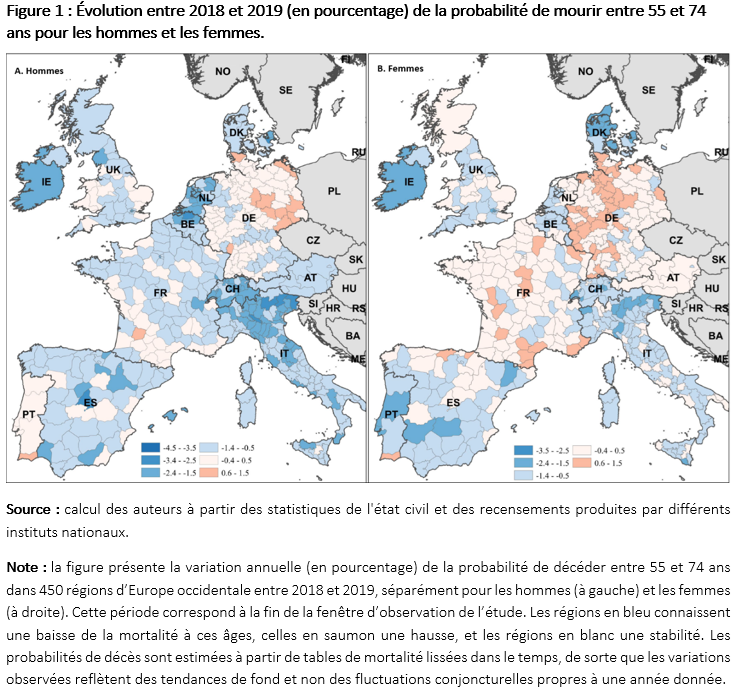
Source: Authors’ calculations based on civil register statistics and censuses done by different national institutes.
Note: Figure 1 presents annual variation (%) in the probability of dying between ages 55 and 74 in 450 western European regions between 2018 and 2019, with men’s situations on the left and women’s on the right. The period involved was the last two years of the study’s observation period. Regions in blue saw a decrease in mortality at those ages; those in pink, an increase; regions in white remained stable. The probabilities of dying were estimated on the basis of life tables smoothed over time so that observed variations reflect deep-seated trends rather than fluctuations related to immediate contexts and specific to a given year.
Source :
Bonnet F., Alliger I., Camarda C.G., Klüsener S., Meslé F., Muhlichen M., Thuilliez J., Grigoriev P., Potential and challenges for sustainable progress in human longevity, Nature Communications, 2026. DOI : 10.1038/s41467-026-68828-z