

How INED’s legal department operates in connection with INED activities
Matters of intellectual property and artificial intelligence are at the core of legal service expertise. INED’s legal department intervenes at various research project stages to advise researchers and support service members; its work includes partnership contracts, grant or subsidy applications, and confidentiality agreements.
Vanessa Bennai is a legal expert specialized in intellectual property and innovation. She has worked in both the industrial and research worlds, but now works exclusively for INED.
(Interview conducted in December 2025)
What path brought you to INED?
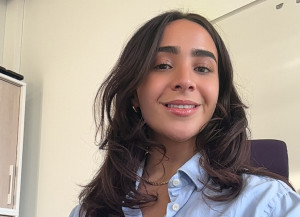
I trained in intellectual and industrial property law because I’ve always been interested in the relations between law, innovation, and research. I did a Master’s-1 degree in “Intellectual Property Law/ Information Technology Law” at the University of Paris-Saclay and a Master’s-2 degree in a program called “Industrial Property and the Health Industry” at the University of Paris 8, during which time I was also working in the Netherlands. I then trained at the Center for International Intellectual Property Studies, once again on questions of intellectual property, but also on AI.
After graduating I gained experience in a quite a lot of different work environments: the pharmaceutical industry, different associations, a hospital foundation, and more recently at two major public research institutions, the National Health and Medical Research Institute or INSERM, and INED. These experiences taken together taught me how to practice not only legal rigor and precision but also a more pragmatic approach focused on team needs. Little by little I moved in the direction of the research world because it’s a sector where the law is more than a formality, it’s a genuine lever that enables research projects to exist and move forward. Joining INED has been an opportunity for me to use my training and acquired skills in the service of a public research center working on major social issues and to work in a multidisciplinary, internationally oriented framework.
Can you tell us more about your role at INED?
INED’s Legal Department encompasses several professions and areas of expertise that, taken together, operate to accompany the Institute as a whole. I’m the Department’s expert on conventions, legal agreements, and my role is to ensure the legal soundness of INED projects by accompanying the Institute’s leading officers, support services, and researchers. In practice, I draft, analyze, and negotiate partnership and consortium agreements [1], public subsidies, and confidentiality agreements.
But behind the texts and provisions, my aim above all is to create a clear, reliable framework within which INED teams can concentrate fully on their scientific work. What I particularly appreciate at INED is the ongoing dialog with quite different interlocutors and the feeling of making a concrete contribution to the success of INED projects.
The work of Legal Department team members is complementary: our department head coordinates and supervises all files, an Intellectual Property colleague of mine is in charge of questions related to intellectual property and publishing, and our Human Resources legal assistant handles questions related to labor law and human resources. Together we ensure that INED operates at all times within a solid legal framework while being ever-agile and active in accompanying research.
What, in your opinion, is special about INED? What do you appreciate the most at the Institute?
INED has a specificity that I see as unique: it brings together researchers from a very wide variety of disciplines working on essential social questions and issues such as migration, inequalities, gender relations, mobility of all kinds. This wealth of intellectual, multidisciplinary pursuits gives a great deal of meaning to my work. What I appreciate most is the Institute’s collaborative spirit and human dimensions. INED is an institution of human size, where exchanges with interlocutors are straightforward and constructive. As a legal expert, I’m not here only to validate contracts; I’m participating in a collective dynamic: I provide counsel, accompany, help move projects forward. And it’s this proximity to the researchers, combined with the Institute’s overarching mission to serve the general interest, that makes my work particularly motivating and gratifying.
[1] These are agreements between several entities for large-scale research projects.