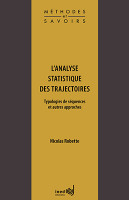

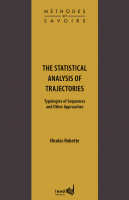
The Statistical Analysis of Trajectories
Typologies of Sequences and Other Approaches
Collection : Méthodes et savoirs
n° 15, 2025
Introduction
From Events to Trajectories
Chapter 1
Creating a Typology of Trajectories
Chapter 2
Measuring the Dissimilarity Between Trajectories
Chapter 3
Describing and Representing Trajectories
Chapter 4
Illustration Using Employment Trajectories
Chapter 5
Multidimensional Sequences
Chapter 6
Working Without a Typology
Conclusion
Appendix
References
In recent decades, changes in residential mobility, family structures, education and careers have driven growing interest in the study of life courses in the social sciences. While quantitative life course research generally focuses on events, analysed using event history approaches, the field also aims to understand trajectories as a whole. There are other approaches that allow life courses to be studied holistically, as units of analysis in their own right. Sequence analysis, the most widely used method, is an invaluable addition to the methodological arsenal of quantitative research, and an essential tool for life course analysis in the social sciences. This practical handbook introduces the reader to sequence analysis and shows how it can be used to build typologies of trajectories. It presents the various decisions involved in its implementation, from data coding to choosing the number of clusters in the typology, and reviews the various ways of measuring similarity between trajectories, a crucial component of the architecture of these methods.
Nicolas Robette (université de Versailles Saint-Quentin-en-Yvelines/Ined)
Nicolas Robette is a demographer and sociologist, a lecturer at the University of Versailles Saint-Quentin-en-Yvelines, and a member of the Printemps laboratory (Professions, Institutions, Temporalities). His research focuses on the sociology of taste and cultural practices, cultural prescription, and methods in the social sciences.
Cet ouvrage est la traduction anglaise de L’analyse statistique des trajectoires (Paris, Ined, 2021)