
Fathers have embraced longer and more flexible paternity leave
Population and Societies
n° 640, January 2026
https://doi.org/10.3917/popsoc.640.0001
Fathers have embraced longer and more flexible paternity leave
Fathers have embraced longer and more flexible paternity leave
Reformed in 2021, paternity leave in France was extended and made more flexible. The proportion of fathers taking this leave continues to grow, particularly among those that used to claim it least, such as self-employed workers, those on fixed-term contracts, and the least-educated fathers. Fathers’ presence at the birth of their child and beyond is becoming the norm. However, occupational and financial pressures remain an obstacle to the use of paternity leave. Only a minority of fathers take a “solo” paternity leave after the mother’s return to work, but these numbers are increasing.
paternity leave, family policy, father, birth, employment, child
Table of contents
- Appendix A References
In July 2021, the French government extended paternity leave to 4 weeks and changed its format. How successful has the reform been? Which fathers are most likely to use paternity leave, and why do some fathers not take it? Drawing on new data from the Families and Employers Survey (FamEmp, 2024), the authors describe how the use of paternity leave has evolved, the characteristics of the fathers who take it, and the format they take it in. 1
Paternity and early childcare leave (in French, congé de paternité et d’accueil de l’enfant) is a key public policy measure aimed at developing bonds between father and child, challenging parents’ unequal distribution of domestic and parental tasks, and reducing gender inequalities at work [1]. In practice, this type of leave promotes the involvement of fathers in parental tasks [2]. Paternity leave has been progressively introduced across almost all of Europe; its duration varies by country and sometimes has been extended. In France, the duration of paternity leave was more than doubled on 1 July 2021: from 11 days, it was extended to 25. Four of these days must be taken immediately after the 3-day period of birth leave (congé de naissance). After this mandatory week,2 the rest of the leave may be split into several periods (see Box 1).
1.
For four out of five births, leave beyond the mandatory week is taken
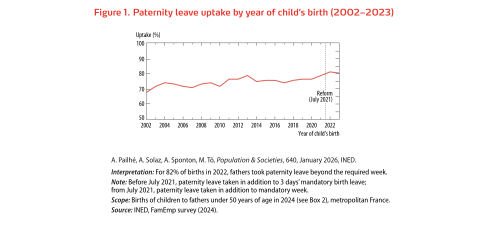
Data from the FamEmp Survey (Box 2) show that paternity leave uptake3 saw a sharp increase in the 2 years following its introduction in 2002, then stabilized at just under 75% in the mid-2000s, and remained at just over that in the 2010s (Figure 1). The significant extension of its duration in July 2021 has not produced any drastic change in uptake but has supported the upward trend that began 4 years prior to the reform. This continuing trend is evidence of an increasing desire among fathers to be present for their baby (and the mother) [4]. For more than 4 in 5 infants (81%) born between July 2021 and December 2023, fathers took all or part of their paternity leave beyond the mandatory week.
2.
Major occupational disparities remain in the use of paternity leave
Use of paternity leave may depend on various factors, including the father’s perception of fatherhood, their awareness of the scheme, and their family and work-related obligations. Family situation makes little difference. Use of leave does not vary according to the sex of the child and varies very little based on family size or father’s age at the time of the birth. It is more closely linked to the father’s level of education: the least educated fathers are slightly less likely to take this leave than university graduates. Above all, however, use of leave is tied to the father’s employment situation before the birth4 (Figure 2). Since the introduction of this leave, fathers employed in the public sector (as civil servants) or in the private sector on permanent contracts are those most likely to make use of their entitlement, followed by those on fixed-term contracts. Self-employed fathers are much less likely to use the leave, and fathers who are unemployed prior to the birth still less so, despite the fact that paternity leave allows them to extend their right to unemployment benefits.
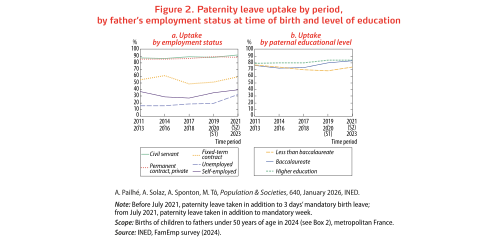
Over recent years, use of paternity leave has increased more among the occupational categories in which it was previously used the least. So, while it remains low, uptake among self-employed fathers has increased significantly since 2017. The incorporation of self-employed workers into the general social protection system in 2018 undoubtedly helped simplify their administrative processes and facilitated the increase in uptake that began shortly before the 2021 reform. Likewise, since 2021, unemployed fathers and those on fixed-term contracts have been taking more leave. Uptake also increased significantly among fathers with only a secondary-school level qualification (baccalaureate), and, by the end of the period, it had caught up with the rate observed among university graduates. Among those without a baccalaureate, while uptake declined between 2013 and 2021, we observe an increase in use of the leave since the reform. The new options introduced by the reform seem to have encouraged the use of paternity leave by a more diverse range of fathers, enabling its increased uptake among those who were previously the most reluctant or least able to take it.
3.
Work-related and financial pressures hinder use of leave
The number of fathers who do not take paternity leave is declining and the reported reasons have also changed. Fathers who have had a child since the 2021 reform are less likely than 10 years ago to report “not wanting” to take their paternity leave (Figure 3). While at the start of the 2010s, this reason—reported by 9% of all fathers and 40% of fathers who did not use their leave—was the most common reason cited for not using leave, it is now the third most common (cited by 7% of all fathers and 35% of those who did not go on leave). On the other hand, work-related pressures, particularly excessive workload, are now more frequently cited reasons. Financial restrictions, perhaps amplified by the inflation observed over the period, are also now more commonly cited. Fears of disapproval from superiors or colleagues, as well as the complexity of the administrative process, are now less frequently advanced explanations. Lastly, 4% of all fathers (1 in 5 fathers among those who did not take leave) reported not currently being entitled to the leave, a figure quite close to the actual non-eligibility rate for the scheme (estimated at 6%).
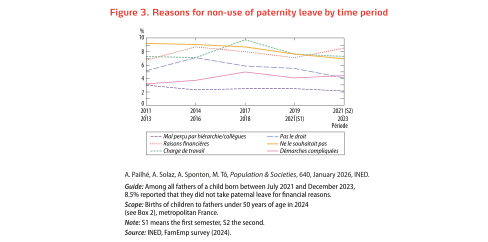
Changes in the reasons for non-use reflect changes in paternity norms since the turn of the century. Fathers’ presence at the time of a birth and use of paternity leave is an increasingly strong social expectation, supported by the healthcare sector [3] and communities, and seems generally well-accepted by workplaces, including since the extension of the leave to 25 days [5]. Correspondingly, fear of leave being “negatively perceived” by superiors or colleagues is cited rarely, and less and less often. This positive cultural context may encourage men to make use of their rights when they can—or prevent them from openly admitting their reluctance to interrupt their work in order to look after their newborn.
Reasons for non-use depend on employment status and level of education. Self-employed workers stand out in that they, far more than other working fathers, cite their workload as an impediment to their use of paternity leave. It is potentially more difficult for them to stop working for a period of time or to find someone to replace them. Workload is also the most frequently cited reason for non-use of leave among fathers who are university graduates. Fathers on short-term contracts, unemployed fathers, and those with the lowest level of education are most likely to cite financial reasons for non-use. These fathers also report, more often than other fathers, being put off by the process required to claim the leave, which they consider too complicated.
4.
Which fathers take all their paternity leave and which split it up?
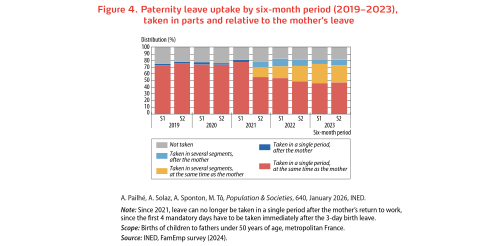
As a reminder, the new leave scheme allows fathers to take all or part of the 21 days beyond the mandatory week; the days can be split into separate periods. The extension of the duration has been very successful. Since 2022, 59% of all births are covered by the full leave entitlement, and 70% of births for which fathers take more than the mandatory week. Splitting the leave into multiple periods has become more popular over time, increasing from 23% among births in the second half of 2021 to 33% among those in the second half of 2023.
Fathers are more likely to take full paternity leave after a first birth than after subsequent ones (full leave is taken after 62% of first births, compared with 57% of second and 49% of third births). This fall in the number of days’ leave taken with each subsequent birth may reflect a more marked division of roles between the parents (associated with the reduction or interruption of the mother’s professional activity), or the greater occupational or financial pressures experienced by fathers as their family grows.
Salaried fathers, whether they are civil servants, on permanent contracts, or on fixed-term contracts, take their full leave more often (75% of births) than self-employed fathers (55%). Splitting of the leave into separate periods is more common among private sector employees (on fixed-term or permanent contracts) and among self-employed workers than among civil servants. Splitting of leave and partial use of paternity entitlement undoubtedly helps fathers to balance paternal involvement with the pressures of work.
The flexibility of the new leave scheme makes it easier to adapt to family and work-related obligations. Use of the option to split the leave varies based on the month of the birth. When the birth takes place during a holiday period (e.g., July or August), the leave is more often used in full and in one single period, while splitting is more common for births in October or March, enabling some of the leave to be deferred until a time more suited to family holidays (e.g., the end-of-year or summer holidays).
5.
Paternity leave staggered with maternity leave: still unusual but growing in popularity
While most fathers take their leave before the mother returns to work, since 2021 more fathers have taken paternity leave without their partner at home. The latter situation applies to 8% of births, versus 2% before the reform (Figure 4). This increase could be linked to the extension of paternity leave and of the window for taking it, and to the option of splitting it up (one-quarter of split paternity leaves are partly taken after the mother’s return to work). This “solo” leave is more conducive to paternal investment in parental tasks [6]. Even since the reform, however, only a small minority of fathers take solo leave. The practice does increase with the father’s level of education, ranging from 9.5% of fathers without a baccalaureate to 11% of those with a university degree. It is also much more common with first (10%) and second (nearly 14%) births than with third ones (4%). This could be explained by the longer maternity leave accorded to these third births, which is also more likely to be followed by an interruption of the mother’s professional activity.
***
Overall, use of paternity leave has increased. Significant media coverage of the debates over its reform may have helped raise awareness around eligibility for the scheme, while reinforcing the idea that use of paternity leave now constitutes a social norm of fatherhood. This reform has enabled fathers to be more present for newborns and their mothers, and for a longer period of time. While its new rules have benefitted the fathers who faced the greatest obstacles to taking leave, as reflected by the greater diversity of users, marked disparities remain in the use of the leave, particularly based on employment situation. Even though some restrictions remain, the use of paternity leave is becoming increasingly widespread and is now common practice for the vast majority of fathers. The current scheme will be further supplemented by the new birth leave (congé de naissance) coming into force in 2026.5
----------------------------------------------------------------
6.
Box 1. Paternity and early childcare leave
Paternity and early childcare leave (congé de paternité et d’accueil de l’enfant) is a period of leave funded by the French social security system and accorded to fathers after the birth or adoption of a child and, in same-sex couples, to the female partners of birth mothers. It was introduced in 2002 and, for employed workers, supplements the 3 mandatory days of birth leave established in 1946 and paid for by the employer. The duration of this optional leave was previously 11 calendar days (18 days for multiple births) and had to be taken in one single period within the first 4 months of the child’s life.
The reform of July 2021 extended its duration to 25 calendar days (32 days for multiple births), thereby according working fathers a total of 28 days’ leave after the birth of their child. Fathers have to take 4 days of paternity leave immediately after the birth leave. The remainder of the paternity leave is optional, can be taken until the child is 6 months old, and can be split into periods of at least 5 days. In practice, a father can therefore take his leave in three segments, by using, for example, 4 days when the child is born, 7 other days several weeks later, and then 14 days at a later time.
Paternity leave guarantees the right to a period of time off work, not only for employees on permanent contracts (contrats à durée indéterminée, CDI) but also those on fixed-term contracts, with no length of service requirements (e.g., fixed-term (contrat à durée déterminée, CDD), temporary, or seasonal contracts), as well as to self-employed workers, farmers, and jobseekers (for the latter, paternity leave defers the termination of unemployment benefits). In the majority of situations, fathers receive an allowance during this period. This sum corresponds to 80% of gross income for salaried workers, up to the daily allowance ceiling for the private sector (€101.94 per day in 2025). Jobseekers can receive an allowance if they are on unemployment benefits or if they have received any benefits during the 12 months preceding the child’s birth. The allowance is then calculated in the same way as for employed fathers. Self-employed workers and farmers are entitled to a fixed-sum allowance (€64.52 per day in 2025).
----------------------------------------------------------------
7.
Box 2. Survey and scope
The longitudinal survey Families and Employers (FamEmp), conducted by INED in 2024, analyses the interrelations between family life and work from the perspectives of individuals and their employers. A total of 41,233 women and men, aged between 20 and 65 years and residing in metropolitan France, took part in the survey, along with around 9,000 organizations employing at least ten workers.
The “individuals” component of the survey asked fathers born between 1975 and 2003 about the paternity leave they had taken following the birth of each of their first three children. If they had not taken any paternity leave, they were presented with various possible reasons, to each of which they responded “yes” or “no”. The options “excessive workload” and “[use is] negatively perceived by your superiors or colleagues” were only offered to working fathers.
The fathers questioned were aged under 50 at the time of the survey. As a result, births at the beginning of the observation period correspond to fatherhood at young ages. For births in 2005, fathers were under 30; for births in 2015, they were under 40.
The paternity leave uptake reported by the fathers is slightly higher than the rate observed based on administrative data for the whole of France [1]. This difference may be explained by the difference in geographical coverage (uptake is very low in the overseas departments of France) and by the over-reporting of fathers, particularly in relation to births that took place a long time ago (memory effect).
The sample contained 8,838 births occurring between 2002 and 2024, of which 1,136 took place after the 2021 reform. Survey weights were applied to all analyses in the study.
----------------------------------------------------------------
Translated by Beatrice van Hoorn Alkena
Appendix A References
-
Gosselin H., Lépine C. 2018. Évaluation du congé de paternité. Inspection générale des affaires sociales (Report). https://www.dialogue-social.fr/websites/dialogue-social/Pieces_jointes_des_articles/2021/Rapport_conge_paternite_2018-022R.pdf
-
Pailhé A., Solaz A., Tô M. 2024. Can daddies learn to care for babies? The effect of a short paternity leave on the division of childcare and housework.Population Research and Policy Review, 43(3), art. 46. https://doi.org/10.1007/s11113-024-09882-7
-
Guedj H., Le Pape M.-C. 2023. Premiers jours de l’enfant : un temps de plus en plus sanctuarisé par les pères via le congé de paternité. DREES, Études et résultats, 1275. https://drees.solidarites-sante.gouv.fr/sites/default/files/2023-07/ER1275.pdf
-
Sponton A. 2023. Des pères absents ? Saisir la diversité du non-recours au congé de paternité à partir de méthodes mixtes. Population, 78(1), 87–121. https://doi.org/10.3917/popu.2301.0087
-
Le Pape M.-C., Dominguez-Folgueras M., Guedj H., Pailhé A., Sponton A., et al. 2025. Paternité : organisation des temps professionnels et familiaux deux ans après la naissance d’un enfant. Les dossiers de la Drees, 126. https://drees.solidarites-sante.gouv.fr/publications-communique-de-presse/les-dossiers-de-la-drees/250123_DD_paternite-organisation-des-temps
-
Bünning M. 2015. What happens after the ‘Daddy Months’? Fathers’ involvement in paid work, childcare, and housework after taking parental leave in Germany. European Sociological Review, 31(6), 738–748. https://doi.org/10.1093/esr/jcv072
Data for the tables and figures are available in Excel format in the ‘Related documents’ tab on INED’s web page for Population & Societies.
For simplicity, we will refer to the 3 days of birth leave accorded to employed fathers and the 4 mandatory days of paternity leave as the “mandatory week”.
In this article, uptake relates to days taken in addition to mandatory leave and is calculated in relation to all births (or adoptions), not in relation to the number of fathers eligible for paternity leave, since the data do not provide details of such eligibility. The proportion of non-eligible fathers is low—estimated at 6% in 2021 [3]—but can vary with the labour market situation.
The survey does not collect this information for the mother at the time of the birth.
This new birth leave, which provides for 1–2 months leave per parent, was voted on as part of the law on social security funding for 2026. It will come into force on 1 July 2026.
Reformed in 2021, paternity leave in France was extended and made more flexible. The proportion of fathers taking this leave continues to grow, particularly among those that used to claim it least, such as self-employed workers, those on fixed-term contracts, and the least-educated fathers. Fathers’ presence at the birth of their child and beyond is becoming the norm. However, occupational and financial pressures remain an obstacle to the use of paternity leave. Only a minority of fathers take a “solo” paternity leave after the mother’s return to work, but these numbers are increasing.
Ariane Pailhé - French Institute for Demographic Studies (INED)
Anne Solaz - French Institute for Demographic Studies (INED)
Alix Sponton - French Institute for Demographic Studies (INED); UMR Center for Sociological and Political Research in Paris (CRESPPA); Centre for Research on Social Inequalities (CRIS)
Maxime Tô - Institut des politiques publiques (IPP); Paris School of Economics (PSE); Centre for Research in Economics and Statistics (CREST); Institute for Fiscal Studies (IFS)
Cite the article
Ariane Pailhé, Anne Solaz, Alix Sponton, Maxime Tô. (2026). Fathers have embraced longer and more flexible paternity leave. Population & Societies, no. 640 https://doi.org/10.3917/popsoc.640.0001
 This document may be reproduced free of charge on paper or online using our Creative Commons licence.