

The current situation of the HIV/AIDS epidemic - 2013
According to UNAIDS estimates for the year 2012, 35.3 million persons are infected with the HIV virus worldwide and there were 2.3 million new infections and 1.6 million deaths that year.

According to UNAIDS estimates for the year 2012, 35.3 million persons are infected with the HIV virus worldwide and there were 2.3 million new infections and 1.6 million deaths that year.

Editors of "Minorités de genre et de sexualité", a recent INED Publications release, answered our questions.

Laurent Toulemon, Director of Research at INED, talks about recent fertility trends in France, comparing them with other OECD countries.

Yuxi Wang, winner of a Marie Skłodowska-Curie post-doctoral fellowship (Horizon Europe), arrived early September 2023 for a two-year stay at INED’s Mortality, Health and Epidemiology research unit, where she’s working under the supervision of INED senior researcher Carlo-Giovanni Camarda.

The Human Multiple Births Database or HMBD, a project funded by France’s Agence Nationale de la Recherche, was awarded the 2023 Open Science Research Data prize for the category “Creating the conditions for data reuse.” We interviewed the INED team working on HMBD.

Senior researcher Patrick Simon tells us about religious diversity in France, including intergenerational transmission of religion and religious practices by inhabitants’ origins.
Contraception Contraceptive methods used by women 20-44 and 15-44

“Period poverty” (précarité menstruelle), though still not taken into account very often, raises many issues and impacts both individuals and society, collective life. INED researcher Valentine Becquet explains why it is so important to talk about menstrual health.
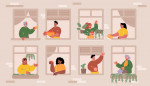
Thirty-five years after the last major national survey on relations between neighbors in France (INED/INSEE “Contacts” survey, 1983), a new survey, entitled “Mon quartier, mes voisins” [My neighborhood, my neighbors], has studied those relations at different scales and documented individuals’ social integration at local (the immediate neighborhood) and extra-local (outside the neighborhood) levels.
Up until the twentieth century, people seldom lived to be a hundred. But since the end of the Second World War, the number of these people, called centenarians, has been rising. On January 1, 2024, France had over 31,000 centenarians, and according to INSEE predictions, it could have more than 200,000 in 2070. Does this necessarily mean that the majority of ...